
So you’ve got a branded podcast. Maybe it’s been running for a few months, maybe a couple of years. You’re getting listens, your host sounds great, and you genuinely believe the content is good.
But there’s a nagging question in the back of your mind every time someone in leadership asks about it: “Who’s actually listening to this thing, and are they the right people?”
That’s the crux of what we’re going to dig into today: how to take the listener data you’re (hopefully) already collecting and use it to figure out whether your podcast is reaching your ideal customer. And if it isn’t, what to do about it.
This isn’t about making your podcast more popular in the abstract sense. It’s about making it more useful to your sales team, your marketing goals, and the actual humans you’re trying to serve.
What is an ICP?
Your ICP (Ideal Customer Profile) is a detailed description of the type of company (and person within that company) most likely to get genuine value from your product or service, and therefore, most likely to buy, stay, and grow with you. It’s a strategic, data-informed profile built from your best customers.
For B2B companies, an ICP typically includes:
- Firmographic details: What kind of company are they? Think industry, company size, annual revenue, stage of growth, geographic location, and tech stack. A Series B SaaS company with 50–200 employees is a very different buyer than a 10,000-person enterprise in financial services.
- Demographic and role details: Who inside that company are you actually selling to? This means job title, seniority level, department, and functional responsibility. Are you going after VP-level folks? Directors? Practitioners? All of the above?
- Psychographic details: What does your ICP care about? What keeps them up at night? What content do they consume? What are their professional values and motivations?
When all three layers line up (the right company, the right person, the right mindset), that’s your ICP.
Why branded podcast-ICP alignment matters
Here’s the thing about branded podcasts: they’re not a spray-and-pray medium. Unlike a social ad or a billboard, a podcast requires a meaningful time commitment from the listener. We’re talking 20, 30, sometimes 40+ minutes of someone’s day. That’s an incredibly valuable exchange.
But that value only compounds when the people giving you that time are the people you actually want to reach.
Imagine you’re a B2B marketing team at a mid-market HR tech company. Your ICP is an HR Director or VP of People at a company with 500–1,000 employees. If your podcast is mostly pulling in solo entrepreneurs and entry-level HR coordinators, you’ve got a mismatch, no matter how high your download numbers climb.
Downloads don’t tell you who’s listening. And “who’s listening” is the whole game.
The good news is that in 2026, the data tools available to branded podcast teams have matured significantly. You no longer have to guess who’s tuning in.
What podcast listener data is available to you?
Before you can align your listener data to your ICP, you need to know what data exists, and more importantly, what’s actually worth paying attention to. Here’s a practical breakdown of the three layers, and what each one can tell you.
Foundational metrics
Downloads, subscribers, followers, and unique listeners. These are the metrics most podcast teams report on, and they’re not useless, they’re helpful for benchmarking growth over time, tracking output consistency, and giving leadership a quick pulse check.
But they tell you almost nothing about who is listening. Think of them as the surface level. Necessary, but nowhere near sufficient for a B2B team trying to prove strategic value.
Engagement metrics
This is where things start to get more meaningful. Engagement metrics show you how your content is actually landing with listeners, not just whether they pressed play.
The key ones to watch:
- Consumption rate and average listen duration tell you how much of an episode people are actually getting through. A general benchmark worth aiming for is 75% or higher. If you’re consistently falling below that, something in your content or format is causing people to check out early, and it’s worth investigating. You can find this data directly in your CoHost dashboard. Watch a walkthrough here.
- Drop-off points go even deeper. Rather than just knowing that people left, you can spot patterns to see where more listeners left. Too many ad reads back-to-back? A segment that ran long? A guest conversation that wandered off-topic? Drop-off data gives you the specific feedback you need to tighten up your episodes and keep listeners engaged all the way through.
- Completion rates show how many listeners stuck around until the end. They’re a strong signal of content quality and audience satisfaction.
- Listener reviews round out this layer with qualitative feedback. What are people praising? What are they pushing back on? For brands, consistently high retention and strong completion rates signal something important: your podcast is building real connections, not just reach.
Audience metrics
This is where it gets genuinely interesting for B2B marketers, and where most podcast teams are leaving serious value on the table.
Advanced Audience Demographics
CoHost’s Advanced Audience Demographics goes beyond the basics, giving you a genuinely detailed picture of who your listeners are, not just as podcast consumers, but as people.
This matters because ICP alignment isn’t only about job titles and company sizes. It’s about confirming that the humans behind those titles match the profile of the audience you’re trying to build for.
Here’s what you can see:
- Age and family makeup: Listener age ranges and household composition, including whether they have kids or pets. Useful context for understanding life stage and purchasing priorities.
- Household income: How much your listeners earn annually, which helps you gauge buying power and validate whether you’re reaching an audience with real budget authority.
- Interests, hobbies, and lifestyle: The topics, activities, and lifestyle categories your listeners are drawn to. When you know your audience is deeply interested in professional development, sustainability, or technology, you can plan episodes and guest lineups that speak directly to those affinities.
- Social media habits: Which platforms your listeners are active on, how often they engage, and what content formats they prefer. Instead of spreading your promotion thin across every channel, you can focus your energy on the platforms where your ideal audience already spends time.
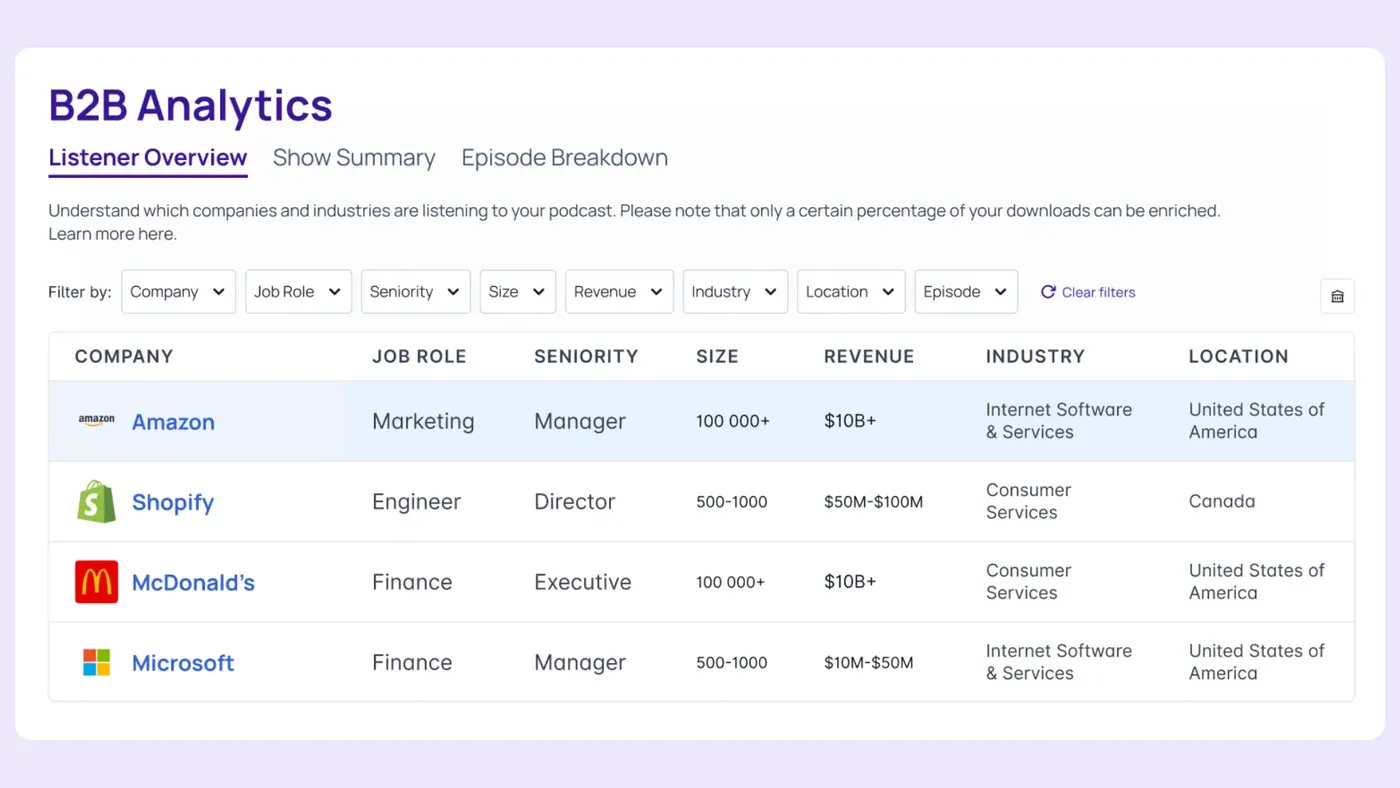
B2B Analytics
This is the one that tends to make B2B marketers’ eyes light up (and for good reason). CoHost’s B2B Analytics tool lets you see which companies are listening to your show, and who inside those companies is tuning in.
Specifically, you can see:
- A breakdown of companies listening to your show, including their industry, location, average company size, and average revenue
- The job functions and seniority levels of your listeners, whether your audience skews toward managers, directors, or C-suite, and whether they’re coming from marketing, finance, HR, product, or elsewhere
- An exportable list of companies and contacts, which you can use to identify guest collaboration opportunities, flag high-value prospects for your sales team, or connect directly to your CRM through CoHost’s Salesforce Integration
This data is available at both the show level and the episode level, so you can compare which episodes are pulling in the most ICP-aligned audiences.
How to align your data with your ICP
Okay, so you’ve got (or can get) the data. Here’s how to put it to work.
Step 1: Write down your ICP before you look at the data
I know, this sounds obvious. But you’d be surprised how many marketing teams skip this step and just dive into the numbers. Before you open a single dashboard, get alignment internally on what your ICP looks like. Ideally, in writing, and ideally across your marketing, sales, and leadership teams.
Document the firmographics, the role details, and the psychographics. Be specific. “Mid-market SaaS companies” isn’t specific enough. “B2B SaaS companies with 100–500 employees, focused on the HR tech space, with a VP of People or CHRO as the primary buyer”, that’s something you can measure against.
Step 2: Pull your audience data and compare it side-by-side
Once you’ve got a clear ICP on paper, pull your listener audience data and lay it next to it. Ask yourself:
- What industries are my listeners coming from? Does that match my ICP’s industry?
- What seniority levels are showing up in my firmographic data? Am I reaching decision-makers or individual contributors?
- What companies are represented? Do any of them overlap with my target accounts?
- Where are my listeners located? Does that align geographically with my ICP?
- What are their content interests? Does that track with the problems my product solves?
You’re looking for signal: where are you well-aligned, and where are there gaps?
Step 3: Look at engagement, not just presence
Here’s a nuance that matters: showing up in your audience data and actually engaging with your content are two different things.
Let’s say you see that 35% of your listeners work at companies with 500+ employees, great, that matches your ICP. But if those listeners have an average consumption rate of 20% while your small business listeners are finishing episodes at 80%, you’ve got a story to tell.
Engagement signals interest. And interest signals fit.
Cross-reference your firmographic and demographic data with your engagement metrics. The audience segments with high completion rates and strong retention? Those are your most aligned listeners. Lean into understanding what content brought them in, and make more of it.
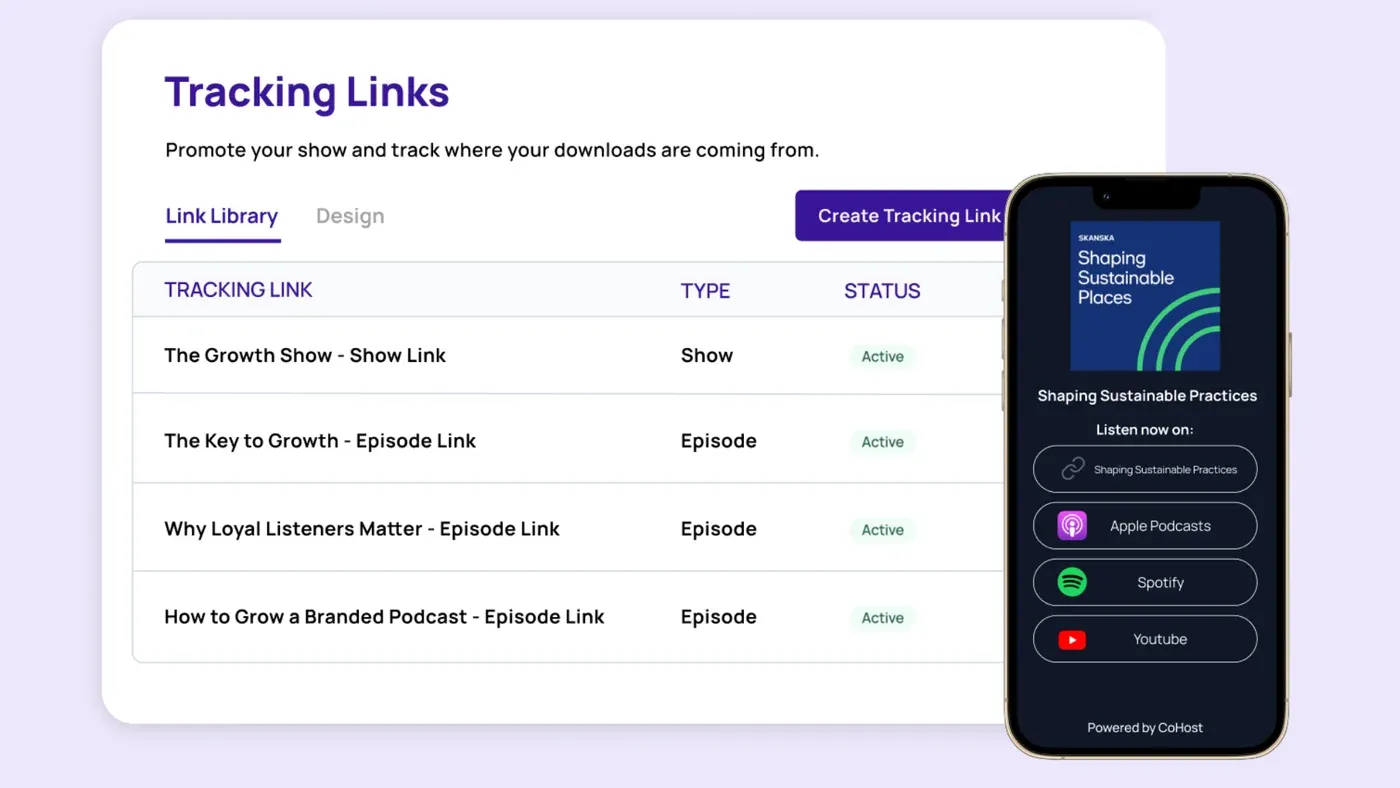
Step 4: Use tracking links to understand where ICP listeners come from
Not all acquisition channels are created equal. A listener who found your podcast through your weekly email newsletter is probably a different person from one who stumbled in through a general podcast directory.
Set up Tracking Links for every promotional channel you use: newsletter, LinkedIn, paid ads, guest appearances on other shows, your website, and monitor which channels are bringing in listeners who match your ICP.
This is incredibly valuable for two reasons: First, it tells you where to put your distribution budget. Second, it helps you understand which messages and content angles resonate most with your target audience before they even hit play.
With CoHost’s Tracking Links, you can generate unique links for every source, and even create them in bulk if you’re launching across multiple channels at once. From there, you get conversion rate data, growth trends over time, and a side-by-side channel comparison so you can see clearly which sources are consistently driving the right listeners and double down on those.
The individual link analytics are worth calling out, too. You can drill down into specific links or episodes to see what content is performing best across different platforms, which is useful not just for distribution strategy, but for understanding what your ICP actually wants to hear more of.
Step 5: Bring sales into the conversation
Here’s where B2B podcast measurement gets genuinely exciting, and also where most teams leave a huge amount of value on the table.
Your sales team has target account lists. Your podcast has company-level listener data. Those two things should be talking to each other.
If your podcast is pulling in listeners from companies that your sales team has been trying to break into, that’s not just a nice data point; it’s a warm signal. Those companies are already consuming your content. Your sales team should know that.
This is exactly why we built our Salesforce integration: to get podcast data out of a silo and into the CRM where sales teams actually live. CoHost syncs company intelligence, audience data, and episode engagement signals directly into Salesforce, automatically and on a schedule you control, whether that’s daily, weekly, or monthly.
That means instead of someone on the marketing team manually exporting a CSV and Slacking it to a sales rep, the data is already there in the account view. Sales can see which target accounts are actively listening, which episodes they’ve engaged with, and use that context to have smarter, more relevant conversations.
It also means you can tie podcast performance directly to campaigns, pipeline, and renewal opportunities inside Salesforce, which is how you build the kind of ROI story that actually lands with leadership.

What to do when your podcast data reveals a mismatch
Let’s be honest: sometimes you’ll do this analysis and find that your podcast audience doesn’t match your ICP very well. Maybe you’re attracting the right industry but the wrong seniority level. Maybe your listeners skew much smaller in company size than your ideal customer. Maybe geographically, you’re off.
Here’s how to address common gaps:
- Wrong seniority level: Look at your content topics and guest lineup. Are you covering strategic, executive-level challenges, or are you going deep on tactical practitioner content? Adjust your topic mix and be intentional about the seniority of guests you book.
- Wrong industry: Examine how you’re distributing and promoting the podcast. Find the communities, newsletters, and platforms where your ICP spends time, and get your podcast in front of them there.
- Wrong company size: This one often comes down to content positioning. Are you speaking to the scale of problems your ICP faces? Enterprise companies have different challenges than startups. Make sure your content reflects the reality of your ideal customer’s world.
- Low engagement from ICP segments: If you’ve got the right people showing up but they’re not sticking around, the content itself needs attention. Look at your drop-off data. What are listeners doing when they leave? Tighten up your episode structure, sharpen your topics, and make sure your intros hook the right person fast.
Build your branded podcast reporting schedule
ICP alignment isn’t a one-time audit. It’s an ongoing practice. Here’s a simple cadence that we suggest:
- Weekly: Check foundational and engagement metrics: consumption rate, unique listeners, any spike or dip worth investigating.
- Monthly: Review audience composition. Are you growing new ICP-aligned listeners? What does your firmographic and demographic breakdown look like this month compared to last?
- Quarterly: Do a full ICP alignment review. Bring in data from Salesforce (if you’re using the CoHost integration, this is straightforward). Are podcast listeners converting to pipeline? Are target accounts engaging? Share this with marketing, sales, and leadership.
The goal here is to build a consistent feedback loop so your podcast keeps getting sharper, more targeted, and more valuable over time.
Make your branded podcast a data-backed channel
For B2B marketers, aligning your podcast listener data with your ICP isn’t a nice-to-have. It’s the difference between running a content experiment and owning a strategic channel.
When you know who’s listening, their seniority, their company size, their industry, their engagement patterns, you stop making decisions based on gut feel and start making them based on evidence.
You can walk into a leadership meeting and say, “70% of our listeners are decision-makers at companies that match our ICP, and three of our top target accounts have been actively engaging with our content for the past two months.” That’s the kind of proof leadership is looking for, and a clear way to secure continued investment.
The brands winning with podcasts right now aren’t necessarily the ones with the biggest audiences. They’re the ones who understand their audiences deeply and use that understanding to improve every single quarter.
To keep up with all things branded podcasting, subscribe to our bi-weekly newsletter, Tuned In.