

After speaking to hundreds of brands about their podcasts, there’s one thing that I’m certain about: Podcasts are no longer an experimental play; they’re strategic content assets that marketing teams lean heavily on to drive reach, thought leadership, community, and even sales.
But the problem that remains is that measuring the impact of branded podcasts can be challenging. Many brands are still turning to downloads as their north star metric. That’s like having web traffic as your primary metric for marketing campaigns.
The problem?
It doesn’t give you any of the meat and potatoes of performance:
- Who’s your audience?
- How are they resonating?
- Are they engaging with your content?
- What are they doing after listening?
- Are they retaining?
These are the questions we want answered. And in 2026, let’s make that happen.
This guide will walk you through podcast measurement in 2026, the key metrics that matter, and how to use them to elevate your show’s performance while proving business impact (yes, what we’re all going after at the end of the day).
Alright, let’s dive in and get you some better north star podcast metrics:
Why podcast measurement has needed to evolve
Way back when, when branded podcasts were first entering the market as a content channel (think 2018-2019), businesses didn’t know what the results were going to be.
But what they found was that audiences were engaged, tuning into branded content for upwards of 40+ minutes. Jackpot.
But during the beginning, brands only really had downloads to go off of. Now fast forward 7 years, and there’s a notable shift from vanity to value. Download data is no longer enough to base content and budget decisions on. Brands need more.
There’s also been an increase in expectations from leadership. Executives want to understand the ROI of the podcast, not just the count of listeners. Which is fair, podcasts aren’t cheap, and they eat up a lot of resources to do well.
So, there was a forced shift in the podcast analytics landscape. And that shift was the emergence of tools that could provide more in-depth data around:
- Campaign insights
- Pipeline generation
- Content optimization
- Target audience alignment
Equipped with these insights, brands can now effectively measure the ROI of a podcast and provie it’s value to business objectives.
The 3 layers of podcast metrics in 2026
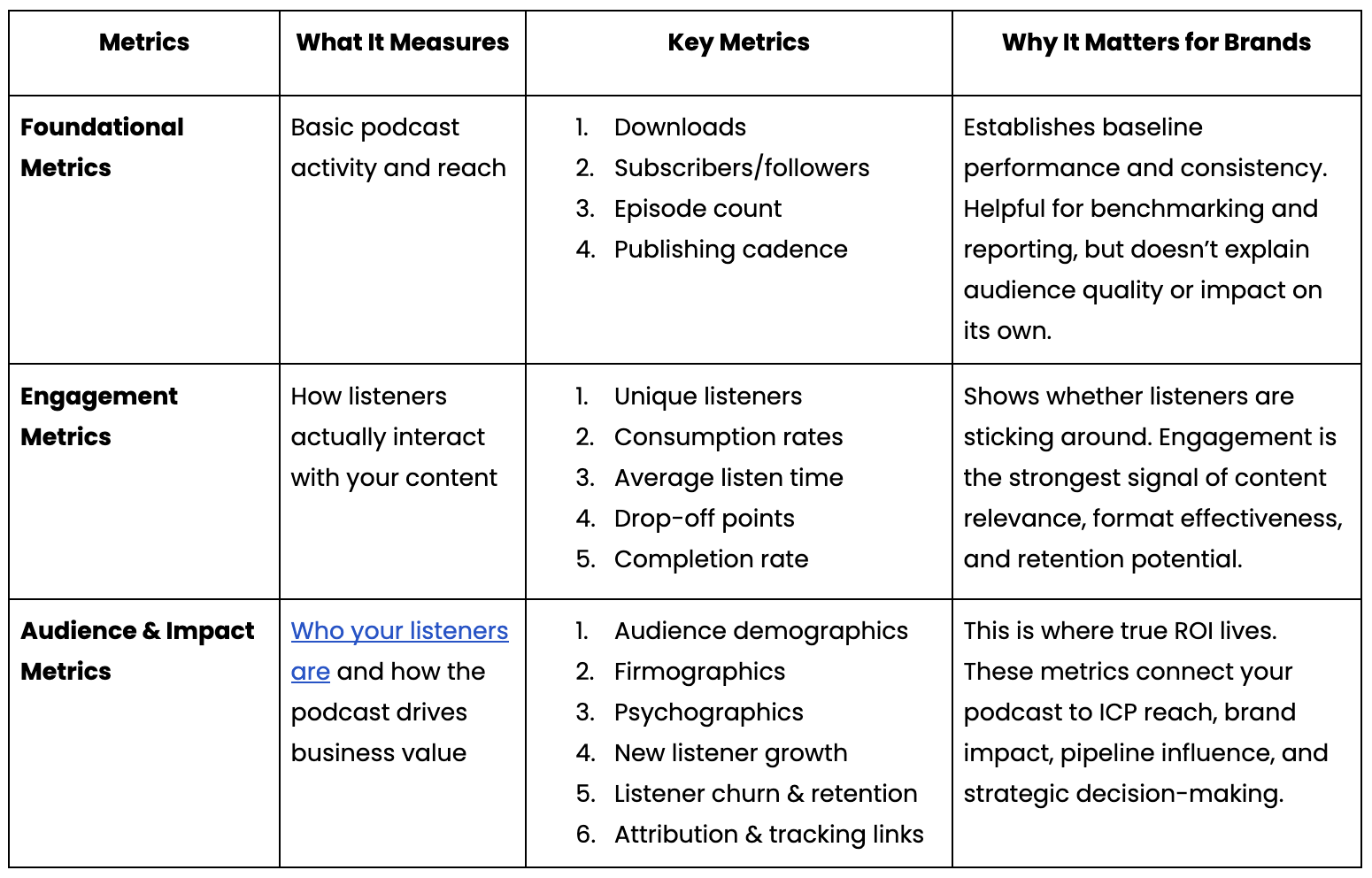
For simplicity, let’s split branded podcast analytics into three main categories:
- Foundational metrics
- Engagement metrics
- Audience and impact metrics
1. Foundational metrics (the starting point)
These are the baseline metrics most marketers are familiar with within podcasting. They give you a high-level view of output and reach… but only scratch the surface of podcast insights.
The metrics:
- Downloads: Total number of times episodes were streamed or downloaded.
- Subscribers/followers: Number of people following your podcast on platforms like Apple or Spotify.
- Episode count & publishing cadence: How frequently you’re publishing episodes (weekly, bi-weekly, seasonal, etc.).
Why they matter:
- Helpful for benchmarking growth over time
- Provides quick wins when starting to track podcast data
- Still important for ad placements, industry rankings, and comparing content volume
Limitations:
- Doesn’t show who’s listening or what they’re doing
- Can’t tell you if your audience is actually engaged or if content is resonating
2. Engagement metrics (audience quality)
Engagement metrics go deeper than surface-level performance. They show how listeners are interacting with your content, such as how long they’re staying, where they’re dropping off, and whether they come back.
The metrics:
- Unique listeners: Individual people who listened to an episode (vs. total plays/downloads). Unique listeners are more indicative to reach compared to downloads
- Consumption rate: The percentage of an episode a listener consumed
- Average listen time: How many minutes of an episode listeners stayed for on average
- Drop-off points: Where listeners tend to stop listening
- Completion rates: How many listeners stayed until the end of the episode
Why they matter:
- Strong indicator of listener loyalty and retention
- Can signal audience satisfaction and brand trust
- Helps identify what content, formats, or guests are performing well
3. Audience & impact metrics (the ROI layer)
This is where podcasting earns its seat at the table. Audience and impact metrics help marketers understand who’s listening, whether they align with your ICP, and how your podcast is contributing to broader brand or business goals.
The metrics:
- Demographics: This includes age, gender, income bracket, education level, family or household makeup, and location
- Firmographics: This includes company name, industry, company size and revenue, job title, job seniority level, and company geographic region
- Psychographics: This includes listener interests and hobbies, content preferences, social media behavior, and professional values or motivations
- New listener growth: How many net new listeners your show is acquiring over a set time period
- Listener churn & retention: Whether your audience is coming back consistently (or dropping off over time)
- Attribution & tracking links: Which channels or promotions are driving the most listens and how listeners are discovering the podcast (e.g., newsletter, paid ads, social)
Why they matter:
- Helps tailor content to the right personas
- Fuels better content, smarter growth campaigns, and stronger guest strategy
- Align podcast goals with real business outcomes (e.g., brand awareness, lead gen, ABM)
- Supports internal buy-in by showing real listener value (e.g., “70% of our listeners are marketing decision-makers in SaaS”)
Most marketers track foundational metrics. Fewer get to engagement. Very few are tapping into audience & impact metrics, but that’s where real differentiation lives.
Where to find and analyze these podcast metrics
There are a few different tools you can use to collect insights on your podcast.
Listening apps, podcast hosting platforms, and podcast analytics tools are the primary sources for data collection. But not all are made similarly.
- Listening apps: Apps like Spotify or Apple provide their own independent listener data, such as consumption metrics, demographic insights, and follower counts. But they are only tracking listeners on their specific apps; therefore, you’re only getting pieces of data rather than the full story… and have to log into multiple apps.
- Podcast hosting platforms: Some podcast hosting platforms go beyond basic metrics like downloads and unique listeners, providing you with more in-depth insights into your podcast audience. This isn’t a guarantee for any hosting provider, so ensure you do your research before signing up.
- Podcast analytics tools: Typically done through prefixes, these tools are focused on providing data for your podcast. Again, ensure you do your research before hitting the green light on one.
In the branded podcast space, many of the existing podcast tools fall short. Why? Because they’re focused on independent creators or networks rather than brands creating content for the growth of their business.
We were experiencing the same issue when trying to gather our own branded podcast data.
So, we solved the problem with CoHost, creating a branded podcast analytics and audience insights tool to support businesses through their growth with audio.
Without being sales-y, I just want to genuinely callout how CoHost fills the gap for brands in podcasting:
- Company-level firmographics
- Audience demographics dashboard
- New listener metric for tracking acquisition
- Unique listeners over time for churn & retention
- Tracking links for marketing campaign attribution
- Consumption metrics unified from Spotify & Apple
Building your podcast measurement framework
As you know, understanding what to measure is only half the battle. The real value comes from building a measurement framework your team can actually use, share, and act on.
Here’s a simple way we like to operationalize podcast measurement within your org:
1. Start with business-aligned goals
First things first, get clear on why the podcast exists.
Common branded podcast goals include:
- Brand awareness and reach
- Thought leadership and credibility
- Lead generation or ABM support
- Community building or customer retention
- Internal communications or employer branding
Your podcast doesn’t need to (and shouldn’t) serve every goal, but it should clearly serve at least one.
2. Map each goal to the right metrics
Once goals are defined, tie them to the metrics that actually indicate success.
For example:
- Brand awareness → Unique listeners, new listener growth, audience demographics
- Thought leadership → Consumption rate, average listen time, completion rates
- Lead gen/ABM → Firmographics, tracking links, listener overlap with target accounts
- Audience loyalty → Retention trends, churn indicators, repeat unique listeners
This step is what helps you tell a performance story.
3. Establish benchmarks and expectations
Podcast growth is rarely linear, and success doesn’t happen overnight. As we’ve said time and time again, it’s a marathon and not a sprint.
Set realistic benchmarks based on:
- Historical performance (last quarter vs. this quarter)
- Episode-to-episode averages
- Season-over-season improvements
Instead of asking, “Did this episode go viral?” ask:
- Are we retaining more listeners than last quarter?
- Are we attracting more of the right audience?
- Is engagement improving over time?
4. Create a consistent reporting cadence
Podcast data is most powerful when reviewed consistently to actually spot patterns.
A simple structure many brands follow:
- Weekly: High-level engagement checks (unique listeners, consumption)
- Monthly: Episode comparisons, growth trends, attribution insights
- Quarterly: Audience shifts, ICP alignment, ROI conversations with leadership
5. Share insights beyond marketing
Your podcast doesn’t exist in a vacuum, and neither should your reporting.
Bring other teams into the podcasting mix:
- Sales: What pain points are listeners resonating with? Can you identify company accounts that sales have been going after?
- Product: Are certain themes or challenges coming up repeatedly?
- Leadership: Is the podcast reaching the right audience and delivering strategic value?
- PR & communications: Are there any noteworthy podcast announcements that can be amplified with PR? Interesting guests, wins, or topics uncovered?
Podcast measurement for brands in 2026
Podcasting in 2026 isn’t about chasing bigger download numbers; it’s about understanding who is listening, why they stay, and what they do next.
The brands winning with podcasts today treat measurement the same way they treat any other marketing channel: with intention, consistency, and a clear connection to business outcomes. Use podcast data to build something even better.
To learn more about the branded podcast landscape, subscribe to our bi-weekly newsletter, Tuned In, or chat with our team about tracking better data for your podcast.