
The people B2B marketers most want to reach are the hardest to reach.
Senior executives don’t answer cold emails. The vast majority ignore display banners. And I’m willing to bet the “quick 15 minutes?” LinkedIn DM doesn’t get through either.
Meanwhile, the traditional channels built to reach decision-makers (trade press, conference sponsorships, gated whitepapers) are more crowded and expensive than ever, and the return keeps shrinking. B2B customer acquisition costs have climbed more than 60% over the past five years, and Gartner finds buyers now spend just 17% of the entire buying journey meeting with all potential vendors combined.
Sorry for all that doom and gloom. But on a more positive note, here’s what does work: Podcasts. Those same executives will sit for 45 minutes at a time, headphones in, giving a show their full attention.
New research from Signal Hill Insights digs into exactly who these high-level podcast listeners are and how they listen. The takeaway for B2B marketers is clear: A branded podcast might be the single most direct line you have to the people who sign off on six- and seven-figure decisions.
This post breaks down who’s actually listening, why the medium works so well for reaching them, how to get in front of them, and how to prove you actually did.
The executives you’re trying to reach are already listening
Signal Hill Insights runs brand lift studies on branded podcasts (about half of them B2B), and they analyzed data from more than 24,000 podcast listener surveys collected for Triton Digital’s Podcast Metrics Demos+ service.
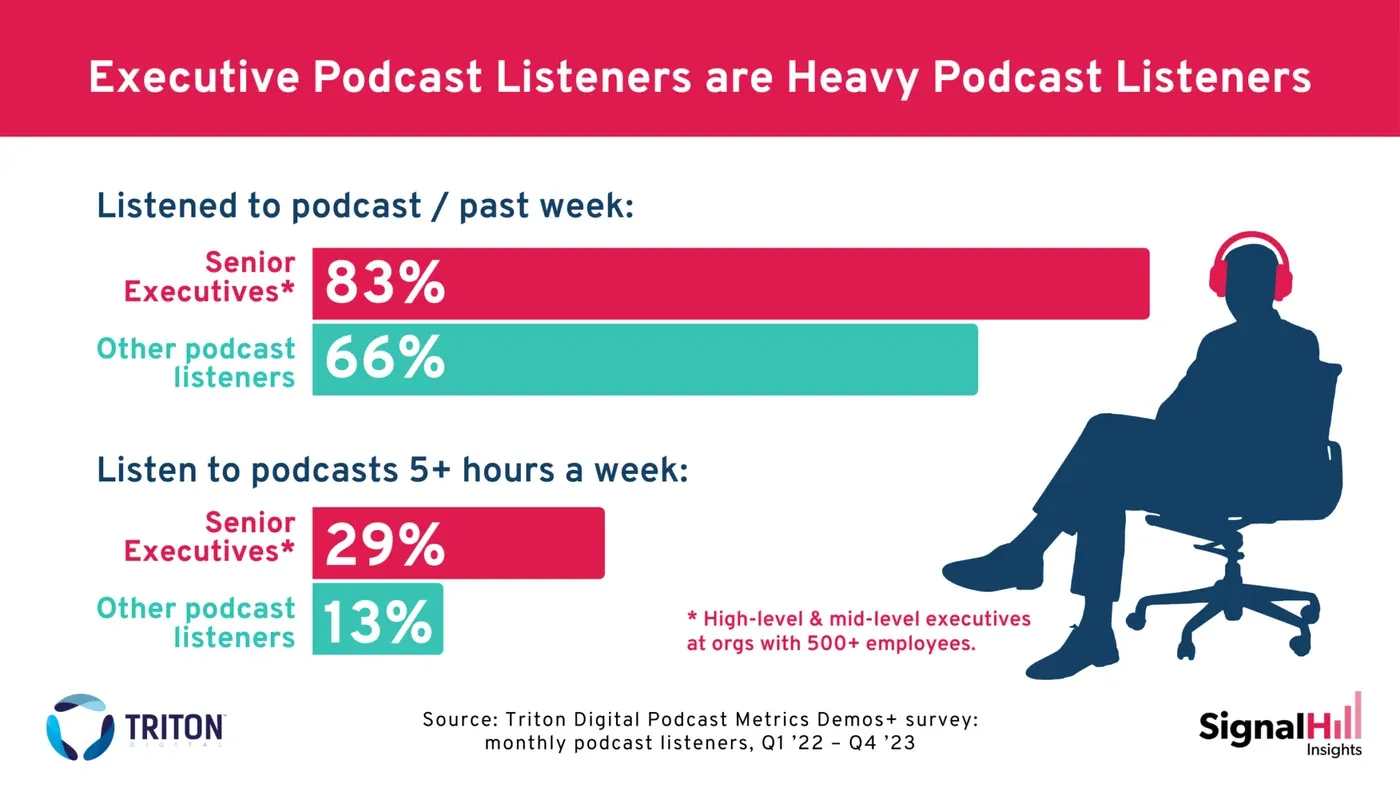
Buried in a sample that large is a segment most marketers assume they can’t reach through audio: High-level and mid-level executives at organizations with more than 500 employees.
That segment makes up roughly 4% of all adult monthly podcast listeners. A small slice, sure. But it’s a small slice of a very large pie, and it’s the exact slice B2B marketers spend their entire budget chasing. More importantly, this group doesn’t listen casually. They go all-in.
Here’s what the data says about how these executives listen:
- They binge: 83% of executive listeners said they’d listened to a podcast in the past week, compared to just 66% of other monthly listeners. And they’re more than twice as likely to be “power listeners” who consume at least five hours a week.
- They’re younger than the stereotype: Executive podcast listeners cluster between the ages of 30 and 49, with nearly half (47%) aged 35 to 44. That’s people entering their peak earning and decision-making years.
- The audience skews male: 73% of senior executive listeners are men, versus 54% of other listeners.
The headline here isn’t “podcasts are popular.” It’s that the specific, hard-to-reach, budget-controlling people your entire funnel is designed around have already chosen this medium, and they’re spending hours tuning in every week.
What these listeners actually want (and why it changes what you make)
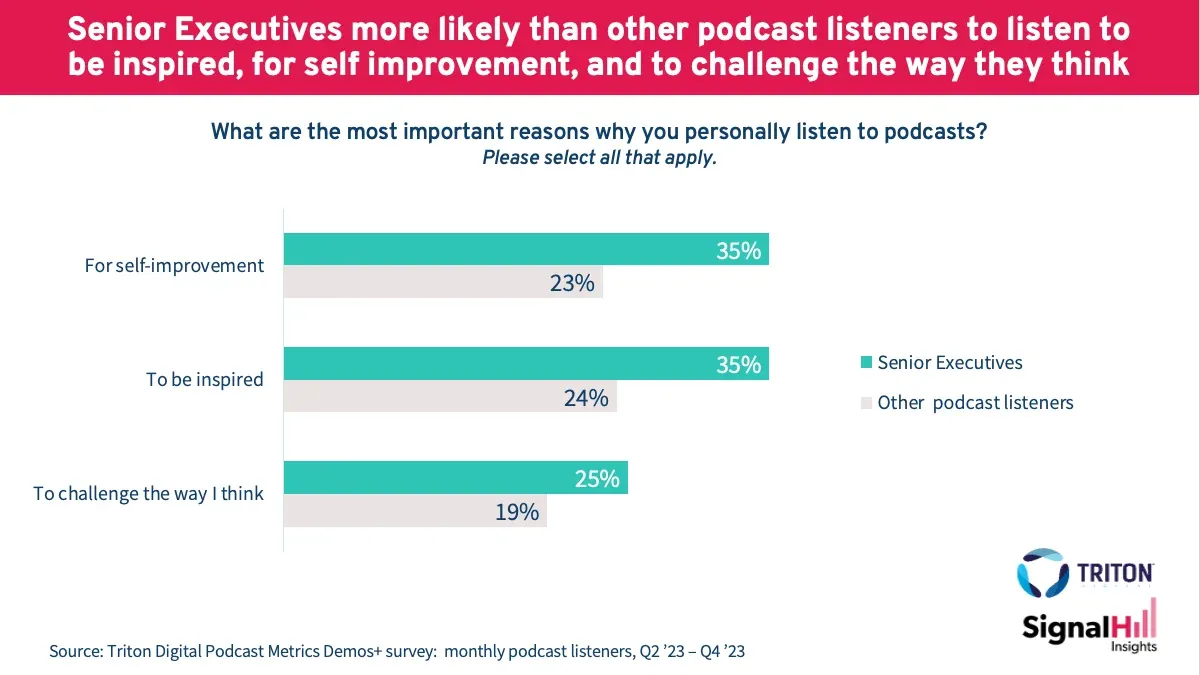
Reaching executives isn’t just about being in the right medium. It’s about giving them something they’ll actually stay for. And the research shows that what keeps them listening is different from the majority of all podcast listeners.
For podcast listeners overall, comedy is the #1 genre. For senior executives, comedy slips to a tie for #2, and news takes its place at the top. Additionally, executives lean harder into business and education podcasts, and they’re more than twice as likely as other listeners to have played a technology podcast.
Dig into why, and it gets even more useful. Signal Hill found that senior executives place added importance on self-improvement, inspiration, and being challenged in the way they think.
With that said, here’s what B2B marketers need to know:
- Lead with genuine insight, not a pitch: The fastest way to lose this audience is to make an ad disguised as a podcast. Share something valuable that can only come from you.
- Have a real point of view: They want ideas that challenge how they think. Take a firm position and share new ideas.
- Respect their intelligence and their time: Surface-level content reads as a waste of both. Assume your listener is smart and take them somewhere a quick Google search can’t.
Why branded podcasts are uniquely good at reaching influential people
Plenty of channels can technically put your brand in front of an executive. What makes podcasts different is the quality of the attention you get. A few things set the medium apart:
You get undivided attention, not a fraction of a scroll
The BBC found that branded podcasts drove 16% higher engagement and 12% stronger memory encoding than the content around them. Listeners leaned in when the brand showed up instead of tuning it out, and the effect held even while they were doing something else (which most are).
Plus, Signal Hill Insights found that 61% of listeners said an episode left them more favorable toward the brand. A branded podcast is the thing your listener actually chose to press play on, which buys you 30 to 60 minutes with a decision-maker. That’s something not many mediums can replicate… especially with our dwindling attention spans.
Listeners opt to tune in
Nobody accidentally listens to your show. They searched for it, maybe subscribed, and hit play. That act of choosing changes everything. You’re not an interruption they’re trying to escape, you’re content they tune into voluntarily.
Long-form builds trust that a 30-second spot can’t
Trust is the entire B2B game, and trust takes time and repetition. Hearing someone’s actual voice, their reasoning, their unscripted answers, week after week, builds a kind of familiarity that written content struggles to match. Listeners start to feel like they know your host. By the time a real buying conversation happens, you’re not a cold vendor. You’re the brand they’ve been listening to for months.
The invitation itself opens doors
The podcast isn’t just how you reach influential people as listeners; it’s how you reach them as guests. “Would you come share your expertise on our show?” gets a yes far more often than a cold pitch, because it’s flattering and puts them in the spotlight. Every episode helps you build a relationship with exactly the person you’ve been trying to get a meeting with, and when it airs, they share it with a network full of similar people.
How to actually get your branded podcast in front of influential people
Knowing executives listen is one thing. Landing in their feed is another. Here’s how to turn the research into a plan:
Make something worth their time
The data says executives want news, insight, and challenge. Build the show around their real problems, book people who’ve actually solved those problems, and cut anything that sounds like a commercial or something they could uncover with a quick Google search.
Meet them where (and how) they actually listen
Executives don’t only listen at their desks. Signal Hill found they’re far more likely than other listeners to fit podcasts into their busy schedule:
- 68% listened while commuting by car (versus 44% of other listeners).
- 51% listened while working out or exercising (versus 31%).
- 29% listened while traveling by plane or train (versus 13%).
That on-the-go pattern shapes where you should show up, too. Because so much of this listening happens away from a screen, far fewer executives name YouTube as their primary podcast platform. Spotify and Apple Podcasts are effectively tied at the top for this group (24% and 23%), with YouTube at 18%.
Compare that to listeners overall, where YouTube leads at 31%. So, you’ll want to make sure your show is available and optimized on Spotify and Apple, and don’t assume a YouTube-first strategy will reach the corner office.
Book the influential people you want to reach
Keep a “dream guest” list that overlaps with your target accounts (your booking calendar and ICP should look suspiciously similar). Invite a senior leader from an account you want to win, then hand them clips, quotes, and copy to share after their episode airs. You’ve now built a relationship and borrowed their audience of fellow decision-makers.
Distribute where professionals actually are
A great episode nobody hears is an expensive hobby. For this audience, two channels do most of the heavy lifting:
- LinkedIn: Clip each episode into short, captioned videos, pull one sharp quote into a standalone post, and always tag your guest so it surfaces to their network. Post from real people (the host, your execs, the guest), not just the brand handle.
- Email and newsletters: Tap into the list you already own. Add an episode callout to your newsletter, slot relevant episodes into nurture flows, and consider sponsoring niche industry newsletters that already reach your ICP.
How to prove you’re actually reaching the right people
Here’s the uncomfortable truth that trips up most marketers investing in branded podcasts: You can do everything above and still have no idea if it’s working.
Vanity podcast metrics tell you how many people downloaded an episode. They tell you nothing about who. And for a B2B show, who’s tuning in is the entire point. A thousand downloads from people who will never buy from you is worth far less than fifty from decision-makers at accounts you’re actively trying to close.
This is the problem we built CoHost to solve. Instead of guessing whether executives are listening, you can actually see it:
- B2B Analytics shows you which companies are tuning in. Company name, size, industry, revenue, and location, so you can confirm your target accounts are in the audience instead of hoping they are.
- Advanced Audience Demographics surfaces who’s behind the download. Job roles and seniority, so you can tell the difference between reaching a VP of Marketing and reaching an intern who shares her title prefix.
- Tracking Links tell you which channels bring in the right listeners. See whether LinkedIn, your newsletter, or a guest’s post is actually driving your ICP, then double down on what works and drop what doesn’t.
- Consumption rate tells you if they’re really listening. A download means someone pressed play. Consumption tells you they stayed. Aim for 70%+ to know your content is holding a busy executive’s attention rather than losing them at minute three.
- The Salesforce integration syncs it all into your CRM. Company, role, and episode engagement land within your pipeline, so a sales rep can open with “I saw your team’s been listening to our episodes on X” instead of “just circling back.”
Is your B2B podcast reaching the right audience?
The research is clear: Senior executives listen (a lot), often several hours a week, with their full attention on the podcast. Most B2B marketers just haven’t committed to meeting them there.
Make something an executive would actually choose to spend 40 minutes on, publish it where they already listen, and use your guest list to start and nurture relationships. Do that consistently, and the show earns a spot on the media plan.
But the part most teams skip (or struggle with) is proving podcast ROI. If you can’t say which companies, industries, and roles are on the other end of the download, you’re guessing, and “we think that the right people are listening” won’t survive a budget review.
That’s the gap CoHost closes: B2B Analytics shows you the actual companies, industries, and job titles tuning in, and Advanced Audience Demographics adds the human layer (age, household income, interests, and social habits). Then, our Salesforce integration syncs it all into your CRM, so podcast engagement shows up in account history and pipeline reporting alongside your target accounts. That’s what lets you report the show with the same rigor as every other channel.
For more on what’s working in B2B podcasting (and what to test next), join the marketers reading Tuned In, our bi-weekly newsletter, or get a live demo of CoHost to start measuring podcast ROI.