
It’s International Podcast Day, which is as good a reason as any to take stock of where branded podcasting actually got to this year.
The short version: It stopped being an experiment.
Not long ago, a branded podcast was something a marketing team could run quietly on the side, and the bar for success was that the show existed and somebody listened. That era is over. Podcasts now sit in content budgets next to paid search and events; they come up on the same review cycle, and they get asked the same questions. That last part is where it gets uncomfortable, because “who did this actually reach, and what did it do for us” is a much harder question to answer about a podcast than about almost anything else you run.
Which is what makes this year’s research worth reading.
2026 was a heavy year for podcast studies. Leaders like Edison Research, Sounds Profitable, and Signal Hill Insights all published new numbers, so we went through the reports and pulled out what’s genuinely useful for brands running their own shows. What kept coming up was a run of findings that quietly contradict how a lot of branded podcasts are being run right now.
Most of it is good news, honestly. But it does mean a few things your team probably takes for granted got tested this year, and they didn’t hold up.
Here are the six findings worth knowing, what each one means for you, and what to do about it.
1. Audio and video move brand perception by nearly the same amount
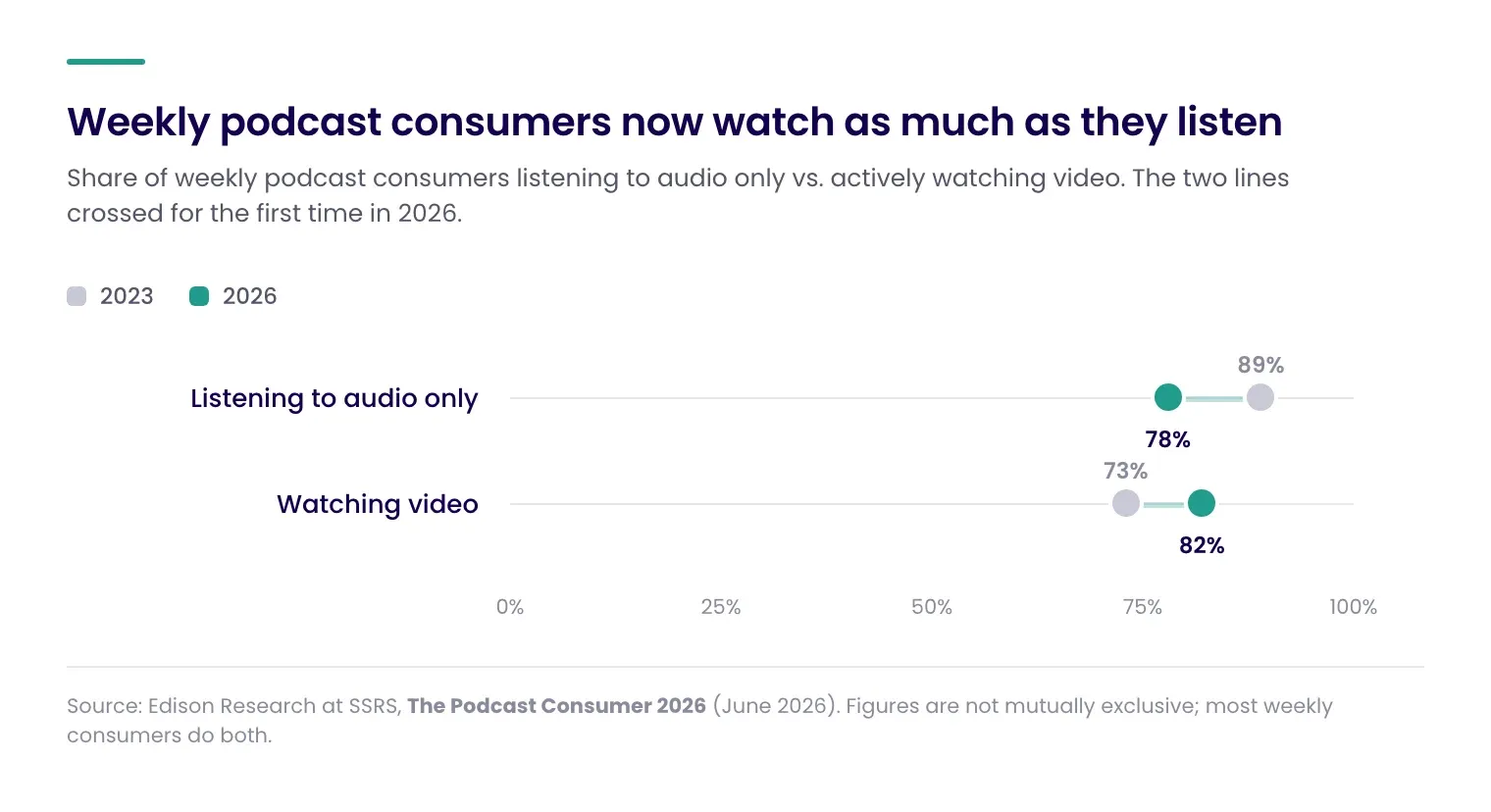
The video numbers this year were genuinely big. Edison Research’s The Podcast Consumer 2026, released June 4, found that 82% of weekly podcast consumers are actively watching video, compared to 78% listening to audio only. In 2023, those numbers were nearly reversed: 89% listened to audio only, and 73% watched.
Signal Hill saw the same shift. Video went from 0% of their brand lift benchmark data three years ago to 54% this year.
They then asked the obvious question: Does a video podcast change how people feel about a brand any more than an audio one does? Across 38,704 listeners and viewers surveyed in 2024 and 2025, the answer was no. They found no notable difference in brand lift between the two formats. Video came out slightly ahead further down the funnel, by 1.1 points in brand rating, 1.5 in consideration, and 2 points in purchase intent, against effects of 11 points or more. The two were identical on brand familiarity.
What this means for brands
Build the video case on reach. Video puts your show in front of people who will never open a podcast app, and 40% of listeners now find their favorite show on YouTube (more on that in finding four).
What the research does not support is a business case built on video making your show more convincing, because the measured difference is too small to plan around. This means video competes with your distribution budget, not your content budget. If you’re choosing between a video setup and a better host, real audience research, or six more episodes, this data says the format is not where the return is hiding.
2. Putting your brand’s name on the show makes people more likely to press play
This is the finding I’d put in front of any executive who still wants the company logo tucked into the last thirty seconds of the outro.
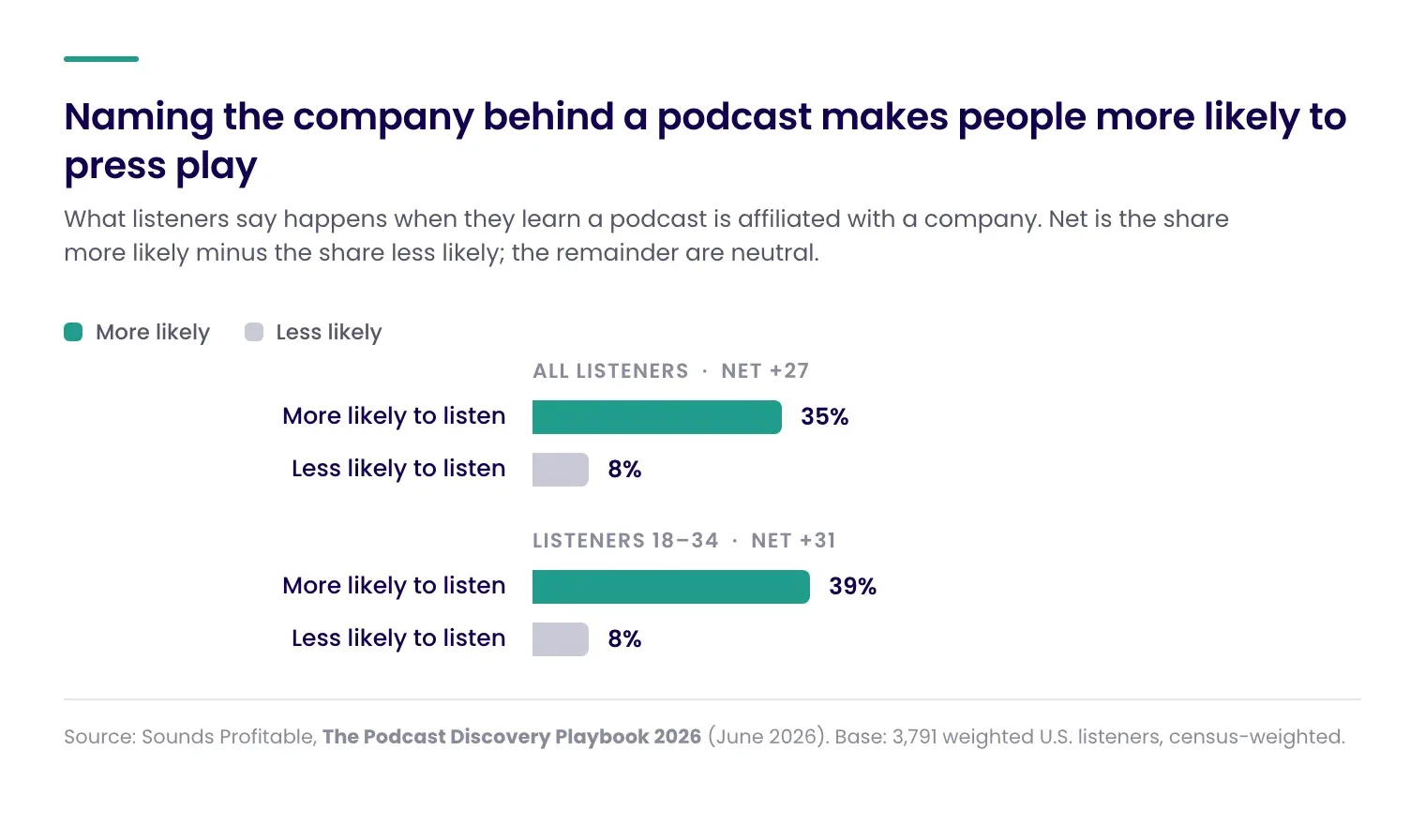
Sounds Profitable’s Podcast Discovery Playbook 2026 asked listeners what happens when they learn a podcast is affiliated with a company. 35% said it made them more likely to listen. 8% said less likely. That’s a net +27 across all listeners, and +31 among 18- to 34-year-olds.
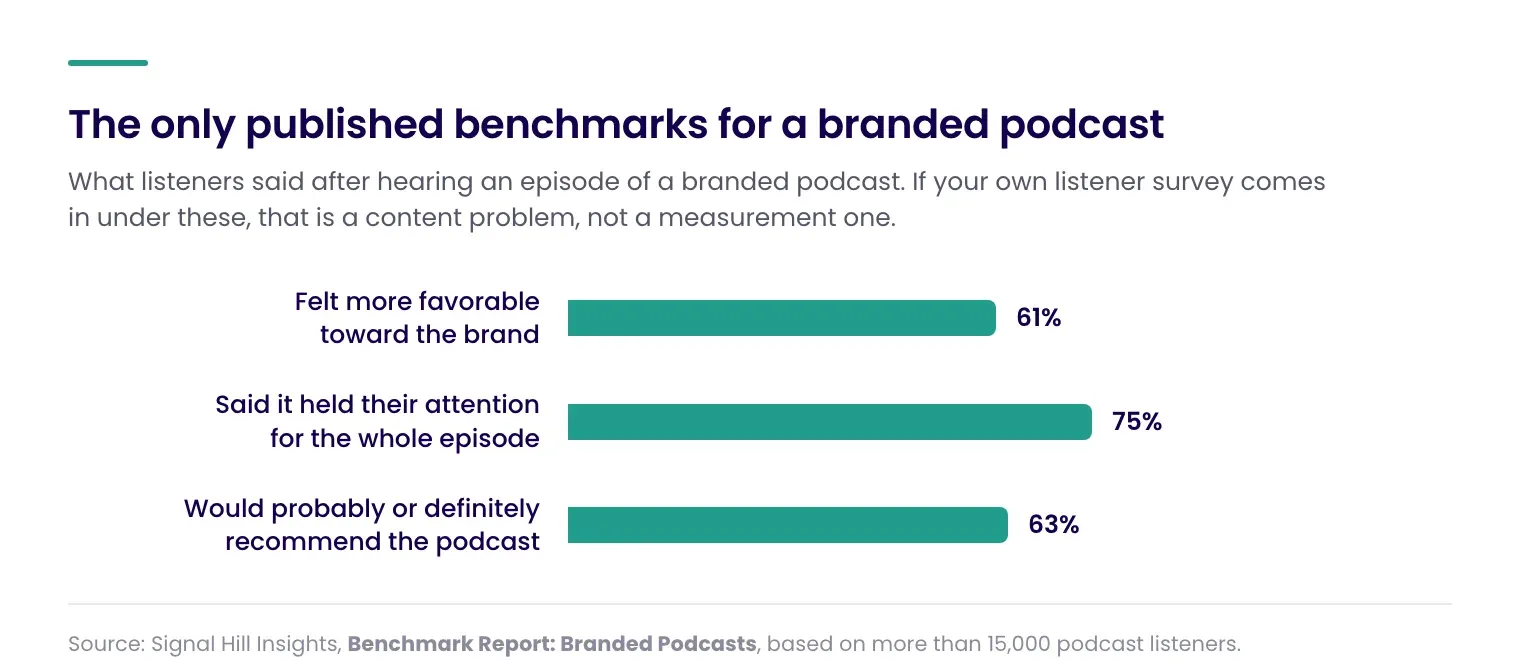
Then there’s what happens after they listen. Signal Hill’s Benchmark Report on Branded Podcasts found that among the listeners surveyed:
- 61% said the episode they just heard made them somewhat or much more favorable toward the brand
- 75% agreed it kept their attention for the entire episode
- 63% said they would probably or definitely recommend the podcast
Signal Hill also dug into why. Listeners who said an episode held their attention were the same ones agreeing with two specific statements: “I was interested in the topics covered in the podcast,” and “the podcast was entertaining.”
One case study from the same report is worth calling out for B2B teams. A sponsored mini-series on financial guidance led 89% of the business decision makers who heard it to rate the brand as “very good” or “excellent.”
What this means for brands
Don’t be afraid of tying your company to your podcast. A lot of branded shows bury the connection, usually because somebody is worried it would put people off, but the research shows that it doesn’t. Far more people press play when they know a company made the show than walk away from it.
I’d also suggest running your own version of a brand lift study to see whether people who have heard your podcast feel differently about your brand after listening. Build a three-question survey asking:
- Whether the episode made them feel more favorable toward your company
- Whether it held their attention the whole way through
- Whether they’d recommend it
Those are the same three things Signal Hill measures, so you get all three benchmarks in the chart above to compare against. Then get your survey in front of listeners. Have your host mention it at the end of an episode, put the link in every episode description, and email it to your marketing list. I’d suggest incentivizing listeners with something small like a gift card.
Remember, this isn’t a like-for-like match with Signal Hill’s, because they had a control group and you don’t, but it doesn’t mean the information isn’t useful. Treat 61% as a rough bar, but you’ll likely find the most value in benchmarking against your own show between seasons to see how your listeners’ attitudes change over time.
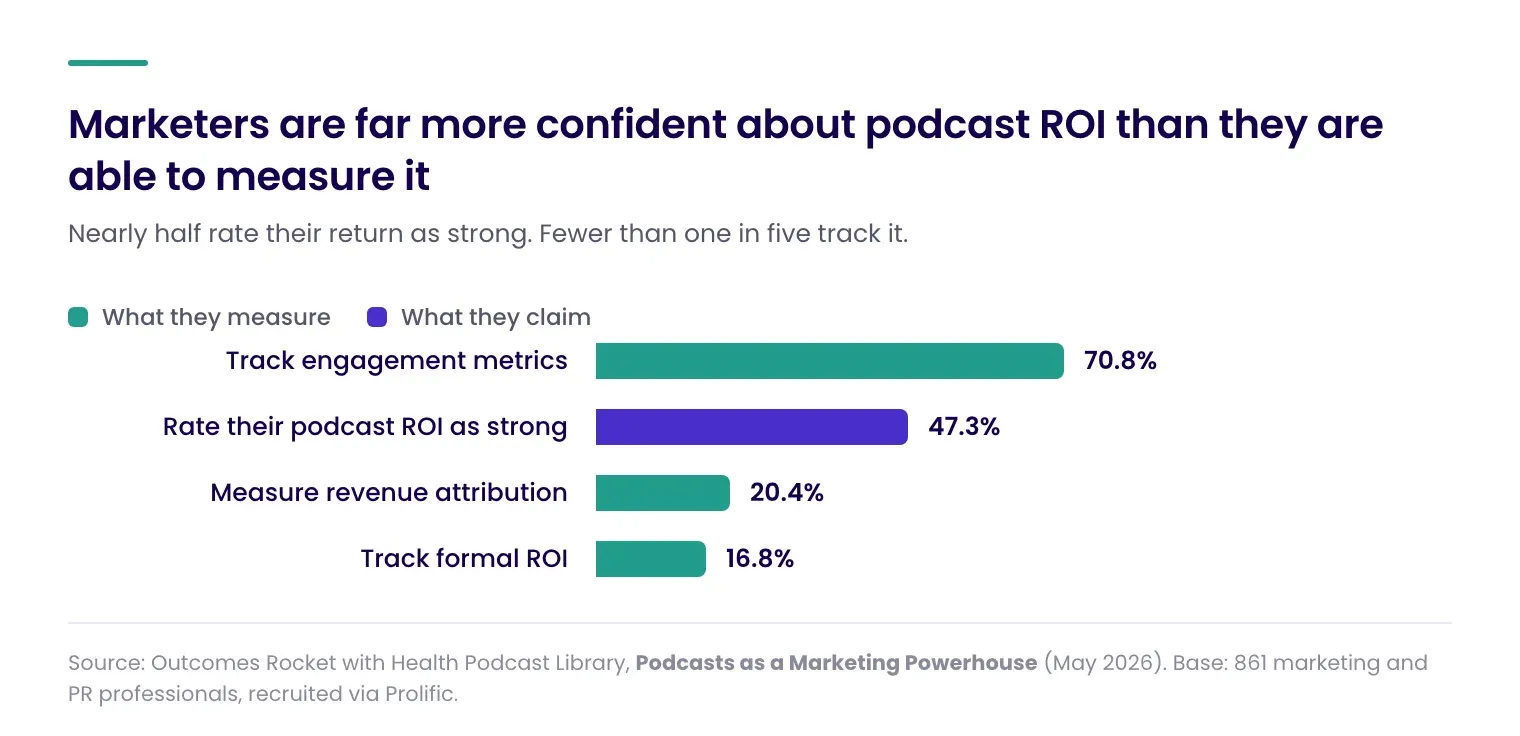
3. Nearly half of marketers say their podcast ROI is strong. Fewer than one in five measure it.
In May, Outcomes Rocket and Health Podcast Library surveyed marketing and PR professionals about how they use podcasts. They found that 44.9% already run podcasts as part of their marketing, another 25% plan to launch within twelve months, and 56.9% plan to increase podcast spend.
In terms of measurement, they found that 70.8% track engagement metrics and 20.4% measure revenue attribution. However, only 16.8% formally track podcast ROI, yet 47.3% report having a strong podcast ROI. In other words: Most marketers who say their podcast is delivering a strong return have no formal way of knowing whether it is.
To be fair, marketers know this is a problem. When asked what they most want to fix over the next twelve months, improving measurement and ROI came second at 31.8%, right behind expanding reach at 36.6%.
So why is it so hard? A lot of it comes down to what these shows were built to do in the first place. 58.1% say brand awareness is their main goal. Only 23.3% are running the podcast to generate leads. And awareness isn’t an easy sell in a budget meeting. We see this even among companies with no podcast at all: 45.8% of them simply don’t believe that podcasts work.
What this means for brands
Many brands are still behind when it comes to podcast measurement. Downloads and vanity metrics alone can’t tell you whether your ideal customer is listening or someone who will never buy from you. So when your CMO asks whether the show is reaching your target audience, the call gets quiet fast.
To help you actually measure podcast ROI, we put together a full framework for it. For the sake of this article, I’ll give you the cliff notes. Measure what it cost you to reach the accounts you’re actually selling to, then hold that against what those same accounts cost you through paid search or events.
Here are the metrics you need to get there:
- Downloads. Your total for the quarter. Pull your unique listener count alongside it, because downloads count auto-downloads and any play over 60 seconds, while unique listeners count each device once. It’s a smaller number and a truer picture of your reach.
- Which companies are listening. Not how many people, but the actual organizations they work for. Most hosting platforms can’t tell you this, but with B2B Analytics you’ll be able to hone in on the companies, their sizes, industries, job titles, and seniorities listening.
- How many of those companies are in your target audience. Match them against your ICP or your sales team’s target account list to see if your show is reaching the right audience.
- What the show really costs you. Include production, hosting, promotion, and any other time or effort your team puts in.
- Consumption rate. The percentage of an episode the average listener actually finishes. This will help you see whether your content is actually resonating with your listeners.
Then there’s one calculation to run. Divide what the show costs you by the number of target accounts it reached, and you have your cost per target account reached. That’s the number that goes on the slide, and it’s the one you compare against your other channels.
4. Most listeners find podcasts on YouTube or social media
The Podcast Discovery Playbook asked listeners two questions: Where they found their favorite show, and where they look for the next one. Here’s what they found:
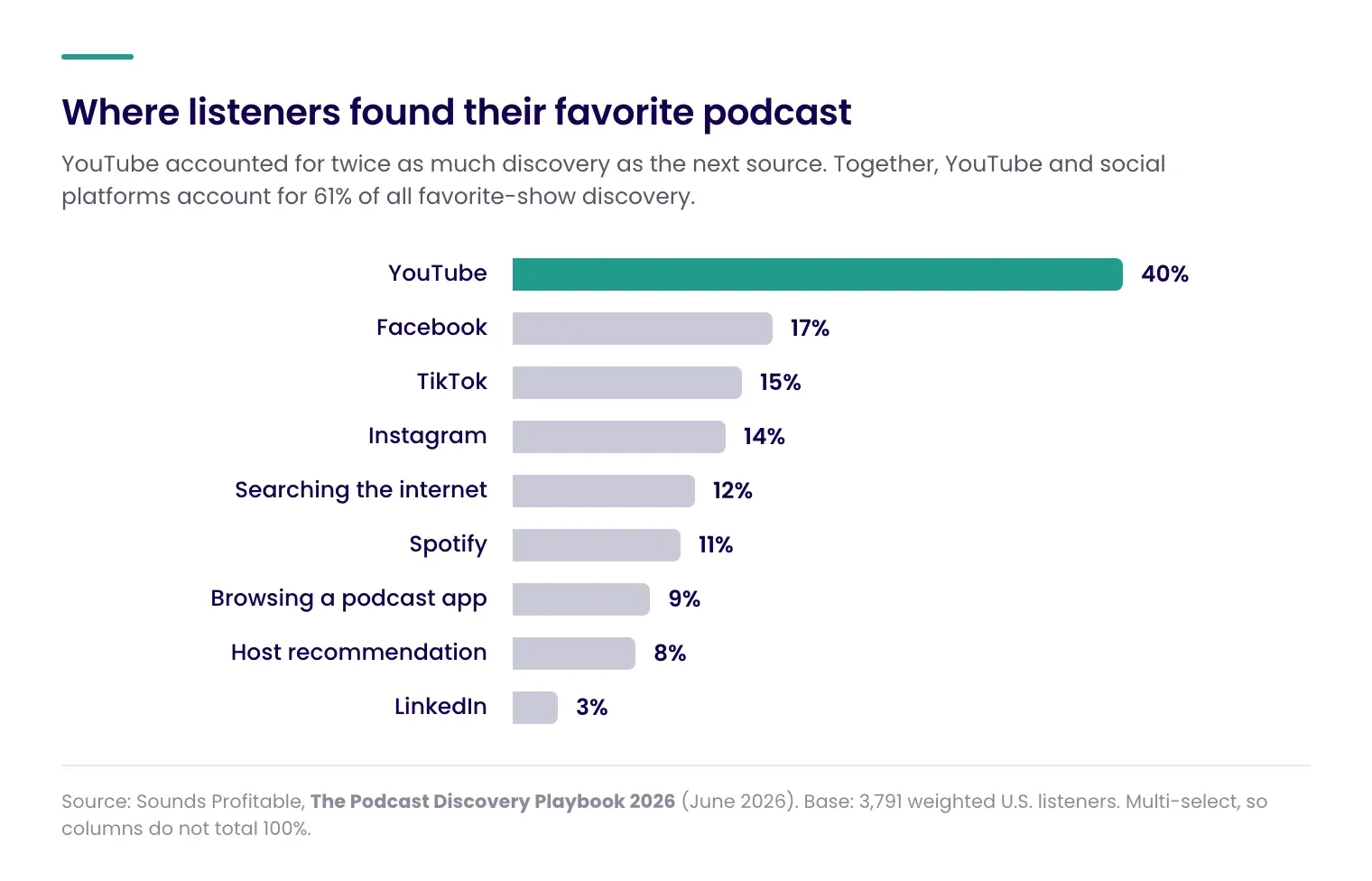
Most people found their favorite podcast on YouTube, and together YouTube and social account for 61% of all favorite-show discovery.
But here’s the part that surprised me. Discovery on YouTube is not algorithmic. 78% of YouTube podcast users find shows through intentional search, with 62% searching for a title and 30% searching by host or guest name. People are typing in what they’re looking for.
The same study also found that:
- Organic beats paid roughly two to one. Among listeners who found their favorite podcast on social media, 60% found it through an organic post by someone they follow, compared to 33% through a sponsored post or ad.
- Word of mouth is the highest-trust channel. 64% get podcast recommendations from friends, family, or colleagues, and 72% say they’re likely to act on them.
What this means for brands
The research shows that people are using YouTube like a search engine to discover podcasts, so it’s more important than ever to show up there, whether you’re producing video or not. If you’re audio-only, upload your episodes with a static image and SEO-optimized metadata. This ensures that your show comes up when someone searches your topic or your guest.
The other thing worth building is word of mouth. 64% of listeners get podcast recommendations from friends, family, or colleagues, and 72% say they’re likely to act on them. It’s also the only channel you can’t buy, which is probably why so few brands plan for it at all.
In B2B, the share is usually internal, one person forwarding an episode to a colleague or their boss, and that’s often how an entire buying committee ends up finding you. So make it easy on them. Produce episodes that make sense and are valuable to someone who’s never heard the show before. Provide your guests pre-written caption and clip options to make sharing easy. That’s the difference between a show people enjoy and a show people send to someone else.
5. Clips are where many of your new listeners actually come from
Sounds Profitable’s Podcast Atlas, in partnership with Signal Hill Insights, surveyed more than 5,000 US adults about how they move between a show’s full episodes, its clips, its video, and its newsletter. The clip findings are the ones that should change what you do.
89% of podcast listeners watch podcast clips on at least one social platform at least sometimes, and 72% do it often or always. Of those viewers, 81% say clips have at least sometimes led them to watch a specific episode, and 84% say clips have at least sometimes turned them into regular listeners.
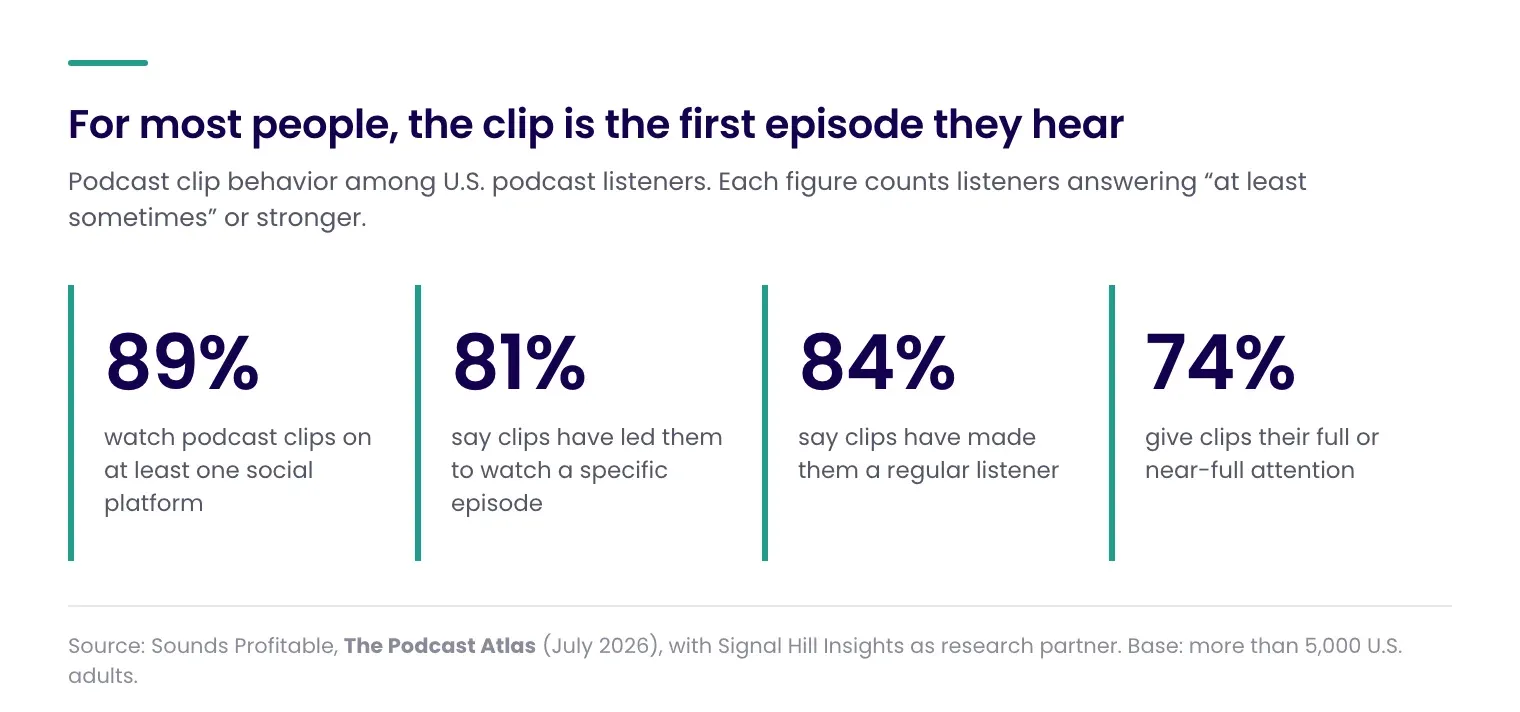
Clips also hold attention nearly as well as full episodes. 74% of clip viewers give them full or near-full attention, against 77% for full audio episodes and 81% for full video episodes.
The loyalty attaches to the person, not the format. 73% of listeners say they’d follow a show from audio into video, and 71% would follow them from long-form into short-form clips. Even newsletters pull their weight: 87% of people subscribed to a podcast newsletter say it leads them to listen to episodes.
What this means for brands
Most teams treat clips as the last job on the list. Someone pulls the ten most quotable seconds after the episode ships, posts it, and moves on. But if 89% of listeners are watching clips and 84% say a clip has turned them into a regular listener, that clip is doing a lot more work than many podcast teams give it credit for. To track how each clip is performing across different channels, we suggest giving each a unique tracking link, so you can see what brought in the most clicks and downloads.
The finding I’d think hardest about, though, is that 73% of listeners would follow a host from audio into video and 71% would follow them into clips. The loyalty is to the person, not the format or the platform. For a branded podcast, that’s a strong argument for one consistent host with an actual personality, rather than rotating in whichever executive is free that month.
6. The question isn’t whether to use AI; it’s where to use it
For many brands, optimizing a podcast for LLMs like ChatGPT and Claude still sounds like a future problem. But the research shows that it isn’t. A new survey found 25% are optimizing for AI answers, on top of the 45% using the podcast to support regular SEO.
Then there’s what listeners make of all this, which is more interesting than the usual “people hate AI” headline. Edison found that 69% approve of AI being used for research, and the same share approve of it for brainstorming ideas. But 62% think AI is a threat to the credibility of podcasts, and 59% think it’s a threat to creativity.
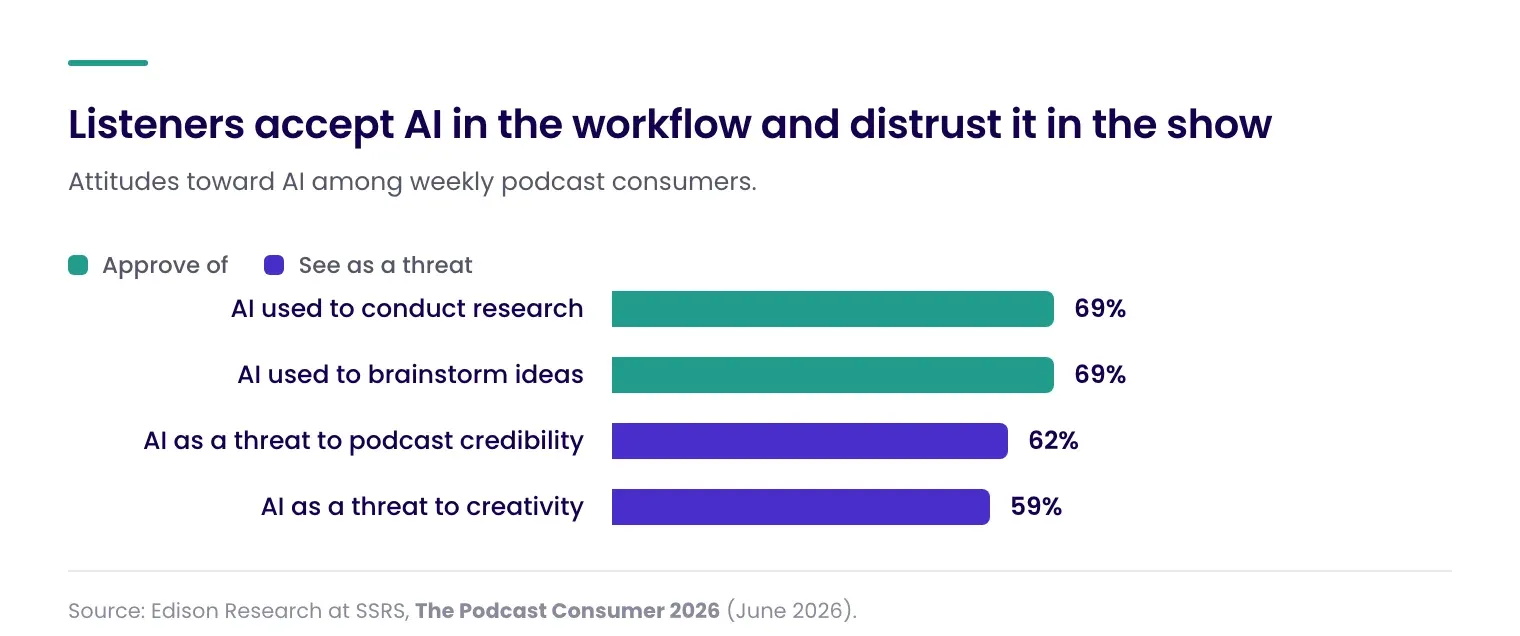
In other words, your audience is fine with AI doing the work they never see, and not fine with it in the thing they’re actually listening to. That’s a pretty sensible place to draw a line, and it happens to be the same one we’d draw.
What this means for brands
Start with the search portion. ChatGPT, Perplexity, and the rest can’t listen to your episode; they read text. So if the ideas in your show don’t exist in writing somewhere, they’re invisible to every one of those tools. What actually gets you cited is a proper recap page per episode, written to answer a real question your buyers are already asking. Our parent company, Quill, wrote a full guide on exactly that.
For everything else AI-related, just use your listeners’ own line. AI off the mic is genuinely useful: Guest research, cutting filler words, drafting show notes, pulling ten clips out of an hour-long recording. None of that touches what people came for. The voice does, and that’s exactly where 62% of them get uneasy.
So what actually changed in 2026?
Here’s the reassuring part, and I’d argue it’s the real headline of 2026: Branded podcasts are working. Listeners are more likely to press play when they know a company made the show, and 61% of them come away liking that company more than they did before. The medium is doing exactly what you hoped it would.
What got tested this year was everything built around it. Where people find you, what a clip is actually for, whether video is worth what you’re paying for it, and whether you can say with a straight face that the show is working.
The good news is that most of those fixes are relatively quick and inexpensive. Name the show something people would search for. Stop hiding your logo. Be intentional about the clips you pull. None of that needs a bigger budget or a rebuild.
But there is one exception, and it’s our favorite topic here at CoHost: Podcast data. If your measurement needs work, here’s where I’d start.
- Write your target account list down before you look at any data. It is very easy to quietly widen what counts as a target until the number improves, and everyone in the room can tell when that’s happened.
- Get company-level data on who’s actually listening. Without it, you’re back to reporting downloads and hoping nobody asks a follow-up question.
- Separate the companies you already knew about from the ones your show surfaced. The first is pipeline your podcast influenced. The second is pipeline it sourced.
- Compare it to your other channels, not an industry benchmark. Work out what it costs you to reach one target account through paid search or an event, then see how the podcast stacks up.
It’s more effort than the other fixes, and it’s the one thing this year’s research can’t do for you. These studies can tell you what podcast listeners look like in general. None of them can name a single company that listened to your last episode, or tell you whether anyone on your target account list has ever pressed play. Only your own data answers that.
To learn more, book a demo with our team. Or, if you want more branded podcast insights like these, subscribe to Tuned In, our bi-weekly newsletter for brand marketers.