Ask a marketing team how they use AI on their podcast and you’ll usually get the same answer. The transcript goes in, the social posts come out.
That’s a perfectly fine use of AI. It’s also the least interesting one.
The bigger wins with AI in podcast marketing happen before you hit record and after the episode goes live. Before, it’s the research nobody has time for:
- Which guests your buyers want to hear from
- What the other shows in your category keep covering
- What your customers keep asking your sales team
After, it’s the part leadership actually cares about, which is:
- Getting episodes in front of the right accounts
- Proving the show is working
AI also got a lot better at this kind of work in the two years since this article was originally written. It can research the web and cite its sources, remember your show from one project to the next, and connect to the places your customer data lives.
What is AI in podcast marketing?
The way I think about it, AI is a very fast research assistant who has read everything and fact-checked nothing. Great at gathering but bad at judging, you need to cover that role.
9 ways brands can use AI in podcast marketing
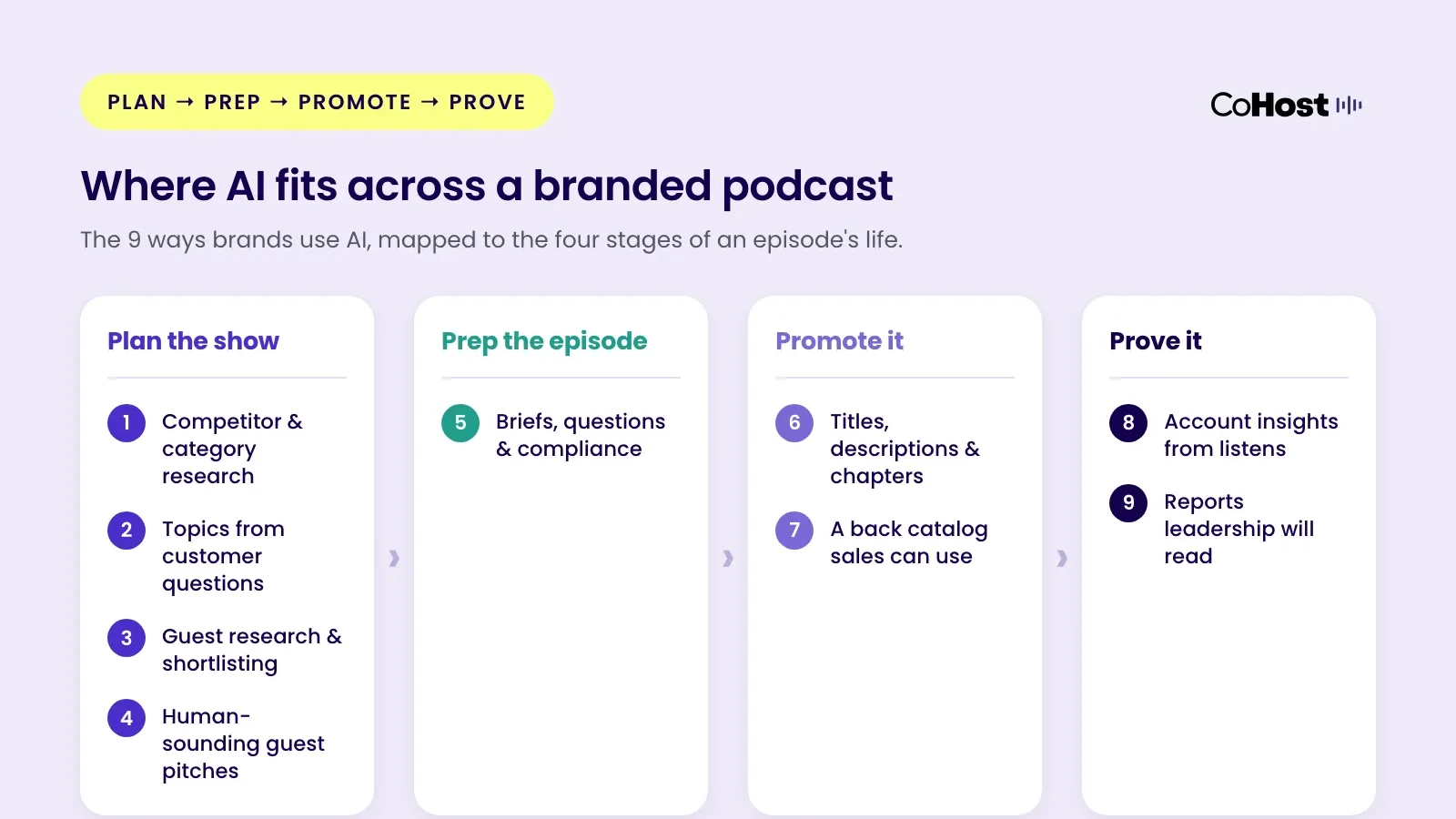
Here’s the full list, grouped by where each one fits in the life of an episode:
Plan the show
- Competitor and category research
- Episode topics pulled from your customers’ actual questions
- Guest research and shortlisting
- Guest pitches that don’t sound like a bot wrote them
Prep the episode
- Guest briefs, interview questions, and compliance pre-checks
Promote it
- Episode titles, descriptions, and chapters
- A back catalog your sales team can actually use
Prove it
- Account insights from your listener data
- Reports your leadership team will read
Each section includes a prompt you can copy. Swap in your details (anything in brackets) and paste it into whichever AI tool your company has approved.
Plan the show
1. Competitor and category research
Before you plan another season, you should know what every other show your buyers might listen to is doing. Not so you can copy them, but so you can stop copying them by accident.
That means who hosts each show, how often it publishes, who it books, what it keeps talking about, and what reviewers complain about. With a research mode (the deep research features in ChatGPT, Claude, Gemini, and Perplexity that search the web and cite their sources), this task turned from a few days of work to an afternoon.
How AI helps:
- Map the category. Ask a research tool to find the branded and independent shows your buyers are likely listening to, with links, so you can check its work.
- Find the crowded topics. Paste in the last 50 episode titles and descriptions from each show and ask AI to group them by topic. If four shows are fighting over the same topic, that lane is full. If nobody is covering something your buyers care about, that could be your opening (or a sign nobody cares, so check it against #2).
- Read reviews at scale. Have AI sort a show’s reviews and comments into what listeners love and what bugs them. Their complaints are free format notes for you.
- Spot the guest circuit. Some guests show up on every show in a category. AI can flag them, so you can skip them or book them with an angle they haven’t done yet.
Try this prompt:
I run marketing for [company], and our podcast, [show name], is for [listeners, e.g. finance leaders at mid-market SaaS companies]. Find 10 to 15 podcasts these listeners are likely to follow, including branded shows from companies in our space. For each one, list the host and company, publishing frequency, typical guest type, the five topics it covers most, and a link. Cite your sources. Then tell me which topics are crowded and which ones nobody is covering well.
Watch out: AI can tell you what another show publishes. It can’t tell you who listens to it or how many. Nobody publishes another brand’s listener data, so if an AI tool hands you a competitor’s download numbers, treat them as fan fiction.
2. Episode topics pulled from your customers’ actual questions
Most branded shows pick topics in a brainstorm. And most brainstorms produce the topics the marketing team finds interesting, which is a slightly different list from the one your buyers would write.
Your best episode ideas are already sitting in your company’s assets. Sales call recordings, support tickets, win/loss notes, customer interviews, the questions people ask at your booth. Nobody has had time to read all of it… but AI does.
How AI helps:
- Pull out the recurring questions. Give AI a batch of call transcripts (from your notetaker or call recording tool) and ask for the questions and objections that come up most, in the customer’s own words.
- Sort by where the buyer is. A question from a first call (“how do other companies handle this?”) makes a different episode than one from a late-stage deal (“how do I get this approved?”). Both deserve an episode.
- Steal their wording. The phrases buyers use to describe the problem make better episode titles than your internal jargon ever will.
Try this prompt:
Here are [20] transcripts of sales and customer calls from last quarter. List the 15 questions or problems prospects raise most often, in their own words. For each one, note how many calls it came up in, what stage the deal was in, and one direct quote. Then suggest a podcast episode angle for the top five that would help a buyer who hasn’t talked to us yet.
Watch out: Customer calls are sensitive. Use an AI tool your company has approved for customer data, strip names where you can, and check with whoever owns the recordings before you start pasting.
3. Guest research and shortlisting
For a B2B show, the guest list is also a target account list (or at least it should be).
Booking a VP from a company your sales team has chased for a year does something a cold email can’t. They spend an hour with your brand, they share the episode with their team, and now you have a relationship instead of a sequence (here’s more on how podcasts fit into your ABM strategy).
How AI helps:
- Build the long list. Give AI your target accounts, your ICP, and the season’s topics. Ask for people at those companies who have spoken publicly about those topics, with links to where they said it.
- See what they’ve already said. Find their recent podcast appearances, conference talks, and LinkedIn posts. If a guest has told the same story on 12 other shows, you want to know before you ask for it a 13th time.
- Check how they talk. Paste in the transcript of a past interview and ask whether they tell stories and take positions, or recite their LinkedIn headline. It’s a quick way to tell a good guest from a good title.
- Run a basic vetting pass. Look at recent company news, public controversies, and whether they work for a competitor (or a competitor’s biggest customer).
Try this prompt:
I’m booking guests for [show], a podcast for [listeners]. Here’s our target account list: [paste]. Find VP-and-above leaders in [functions] at these companies who have spoken publicly about [topic] in the last 12 months, on podcasts, at conferences, in articles, or on LinkedIn. For each person, give me their current title, where they spoke, a one-line summary of their point of view, and a link. Flag anyone who’s been on more than three podcasts this year.
Watch out: AI will confidently hand you someone’s job title from 2022. People change jobs, and research tools don’t always notice. Confirm every name and title on LinkedIn before anything goes out.
4. Guest pitches that don’t sound like a bot wrote them
Everyone can spot AI-written outreach. There’s the same use of em-dashes, fluffy tones, and overusing jargon. “I was so inspired by your recent post on leadership…” about a post they didn’t write is how you end up in the archive folder.
The fundamentals of a good guest pitch haven’t changed:
- Make it specific. Say exactly why you want them: the point they made, the part you’d push back on, the story you’d love them to tell.
- Make it worth their time. Tell them who will hear it (be specific about the listeners you reach) and what they get, like a clip package, the transcript, or a post for their own channels.
- Show you’re legit. Notable past guests, the kinds of companies your listeners work at, a review or two.
- Be clear about the ask. How long, how much prep, video or audio, remote or in person.
AI’s job here is the first draft, built from your research in #3. Your job is to cut it by a third and rewrite the first line yourself. And send it from a real person, not a brand alias.
Try this prompt:
Write a guest invitation email under 150 words to [name, title, company]. Reference this specific idea from their [talk/post/interview]: [paste]. In one sentence, explain why our listeners, [describe them], would care. Be clear about the ask: a 30-minute recorded video interview plus a 15-minute prep call, nothing else. No flattery, no exclamation points, and no “I hope this finds you well.”
Prep the episode
5. Guest briefs, interview questions, and compliance pre-checks
The 15-minute pre-interview is the most underrated part of a good episode, and AI makes it a lot more useful.
Give every host a one-page brief:
- A two-sentence guest bio
- What they’ve already said on other shows (from #3)
- The angle for this episode
- The best stories from the pre-call, so the host can ask for them by name
- The questions, plus anything that’s off-limits (topics legal flagged, competitors, that one acquisition)
Try this prompt:
Here’s the transcript of our pre-interview with [guest], plus transcripts from two other podcasts they’ve been on. Write a one-page host brief with a two-sentence bio, the strongest stories they told in our pre-call, three opinions they hold that our listeners might push back on, and 10 interview questions they haven’t already answered on other shows. Mark which questions are likely to get a story instead of a sound bite.
That last instruction is doing a lot of work. Generic podcast interview questions get generic answers. “What does a typical day look like for you?” has never once produced a clip worth sharing.
In a regulated industry? Before the transcript goes to legal, ask AI to flag every stat that needs a source, every company named, anything that sounds like financial, medical, or legal advice, and any forward-looking statement, with timestamps. Your reviewers still do the review. They just check a list instead of listening to the full hour.
Promote it
6. Episode titles, descriptions, and chapters
A good episode title and description tells a busy buyer three things fast:
- Who the guest is
- What problem the episode tackles
- What they’ll walk away with
Use the words your buyers use (see #2), put the point up front, and cut anything that only makes sense inside your company. Our guide to podcast keywords goes deeper on wording, and Quill’s guide to writing a podcast description covers the show page.
If there’s one thing AI is great for, it’s volume. Ask for 10 title options and you’ll get 10. But the catch is they start to sound the same… or just… strange (sick of hearing “and how to fix it” in every episode title?). Ask your AI for options, try to guide it to get creative and not repetitive, then pick (or write) the one a buyer would resonate most with. Give the selected titles back to your AI project so it can start learning the title styles and formats you prefer/work.
If you publish video episodes, the same transcript gets you YouTube chapters in about five minutes. More in our guide to optimizing your podcast on YouTube.
Try this prompt:
Here’s the transcript of our latest episode. Write 10 episode title options under 60 characters for [listeners]. Use the words a buyer would use to describe this problem, not our internal jargon. No puns and no clickbait. Then write a two-sentence episode description that says who the guest is and what the listener walks away with. If the transcript has timestamps, add a list of YouTube chapters.
7. A back catalog your sales team can actually use
If you’ve published 80 episodes, you have roughly 40-80 hours of experts and customers answering the exact questions your buyers ask. But unfortunately (and very likely), your sales team has listened to maybe four of them.
The content isn’t the problem, it’s that your sales team doesn’t have the time to parse through every episode and identify moments to send to prospects that answer questions they’re asking.
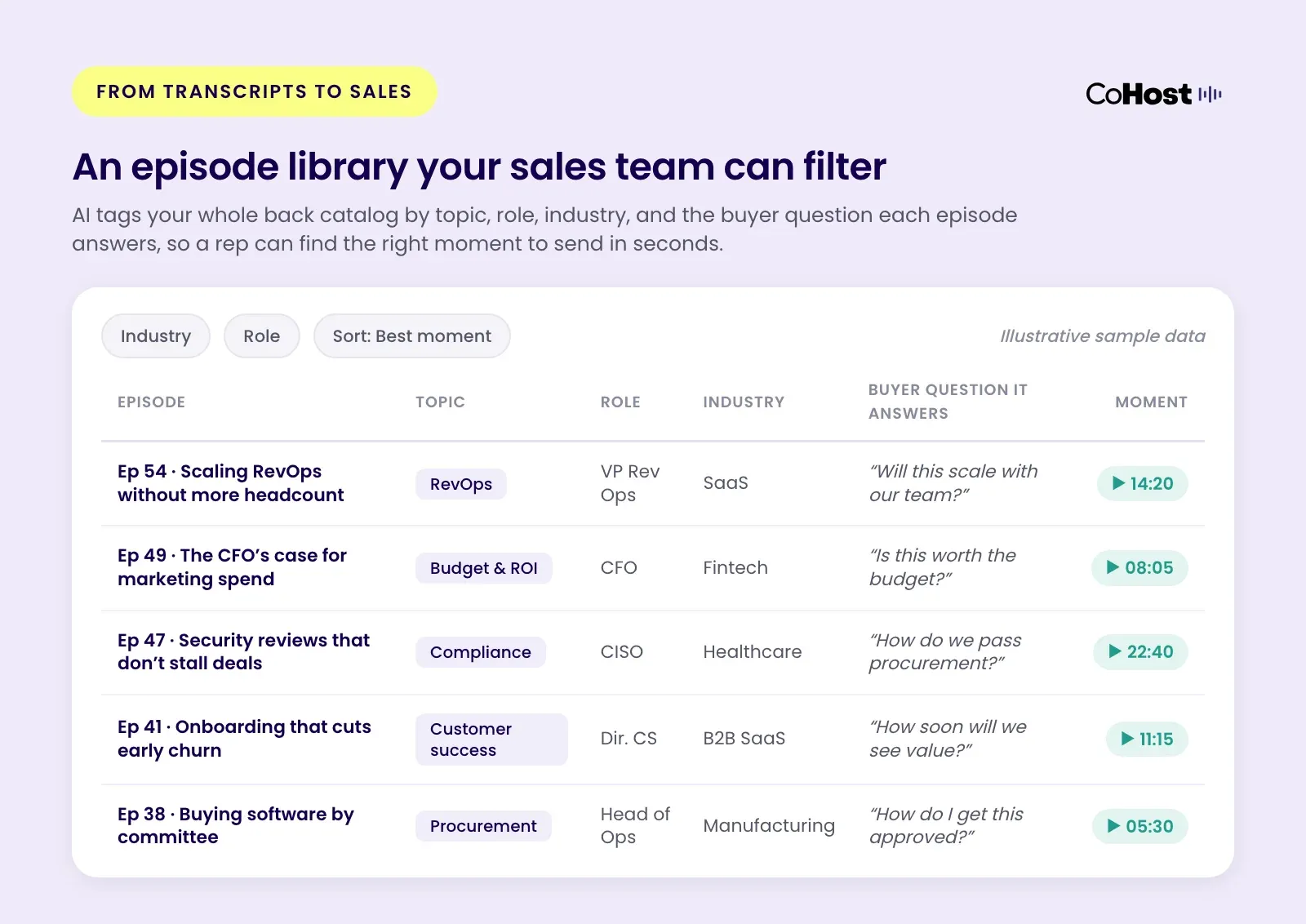
But AI does. AI can tag your whole back catalog with topic, job role, industry, the buyer question each episode answers, and the best moment to send. Put that in a spreadsheet sales can filter, and “CFO at a healthcare company asking if this is worth the budget” turns into three episodes and a timestamp.
Those tags pull double duty:
- Playlists for listeners. Group episodes by theme or role (“start here if you’re new to RevOps”) so new listeners aren’t guessing where to begin.
- Episodes worth a second push. Find the evergreen episodes that deserve to be promoted again.
- Better sales follow-ups. Have AI draft a short follow-up for a rep that points a prospect to one specific moment, instead of “check out our podcast!” because that’s just generic and boring.
Every episode hosted on CoHost is transcribed automatically at 95 to 99% accuracy, so your back catalog is ready to tag.
Try this prompt:
Here are transcripts for [number] episodes of our podcast. For each episode, return one row with the episode title, a one-sentence summary, the main topic, the job role it’s most useful for, the industry (if it’s specific to one), the buyer question or objection it answers, and the timestamp of the best 60-second moment. Format it as a table I can paste into Google Sheets.
Big catalog? Run it in batches of about 10 episodes so nothing gets skipped.
Prove it
8. Account insights from your listener data
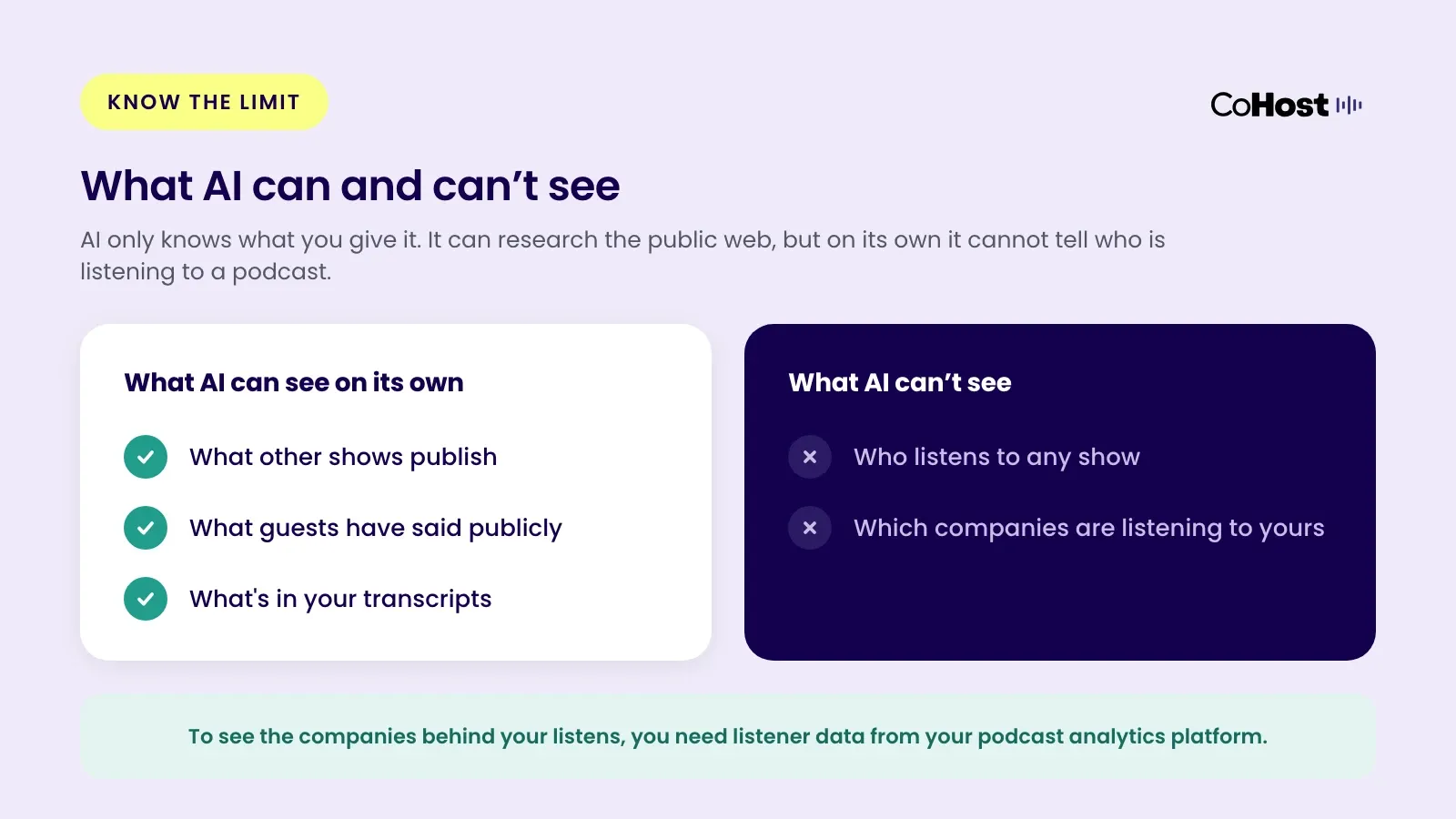
AI can’t see your hosting dashboard, and a download count wouldn’t tell it much anyway. It knows what your show said, but has no idea who actually heard it (your listeners).
So feed it the good stuff so it can know. CoHost’s B2B Analytics shows the companies, industries, and job roles behind your listens, whether you host with CoHost or add the Analytics Prefix to your current host. Pair that with your target account list and your CRM, and AI can do the cross-referencing that you definitely don’t want to dedicate your time to:
- Which target accounts are showing up, and which aren’t. Missing accounts are a signal to adjust guests, topics, or paid promotion.
- Which listening companies are already in your CRM (pipeline the show is influencing) and which are net-new (pipeline it could source). It’s important to report both of these!
- Which industries and roles are growing quarter over quarter.
- Look-alike companies that aren’t on your target list yet but match your best customers.
Then get it to the people who can act on it. A short weekly note to sales (“these five target accounts are listening, and here’s an episode worth sending each of them”) is incredibly valuable. If you host with CoHost on a Premium or Enterprise plan, the Salesforce integration puts listener firmographics right in the account record.
In practice: Russell Reynolds Associates used B2B Analytics to confirm that the new listeners from their growth campaigns for Redefiners were the senior leaders and C-suite executives they set out to reach. That’s the question every paid campaign should have to answer.
Try this prompt:
Here’s a list of companies listening to our podcast this quarter, with industry and job function. Here’s our target account list, and here’s a list of accounts currently in our CRM. Tell me which target accounts appear in the listener list, which listening companies are already in our CRM versus net-new, which industries and roles grew compared with last quarter, and three companies not on our target list that look like our best customers. Show your work so I can check it.
9. Reports your leadership team will read
Nobody on your leadership team wants a 14-slide podcast deck (you wouldn’t either). They want a few short sentences that summarize the impact of the show, and why the budget is worth it.
AI is great at the writing but typically quite questionable at math. So give it the numbers, and don’t let it go find its own. A useful podcast summary for leadership covers:
- What happened (the result, not the activity)
- Why it matters to the business (pipeline, target accounts, reach with the right people)
- What you’re doing next
If you’re not sure which numbers belong in that summary, start with our podcast ROI framework.
Try this prompt:
Here are this quarter’s podcast numbers: [unique listeners, downloads, average consumption, top listening companies and industries, target accounts reached, pipeline sourced and influenced]. Write a five-sentence summary for our CMO. Lead with the business result, not the download count. Use only the numbers I gave you, and don’t calculate anything new without showing the math.
Watch out: AI loves to “helpfully” round numbers, calculate percentages you didn’t ask for, and occasionally invent one. Check every figure against your dashboard before it goes anywhere near your CMO.
What about repurposing?
AI is still very good at turning one episode into a blog post, a newsletter, LinkedIn posts, and clips, as long as you start with a clean transcript and give it your voice guide. We covered the how-to in 5 ways to use AI to repurpose your podcast content. For complete AI workflows from production through promotion, download our free guide, AI in Podcast Marketing: A Complete Guide for Brands.
What AI shouldn’t do for your branded podcast
A few years ago, the big debate was whether AI would replace podcasters. The Podcast Host argued it couldn’t, because listeners come for human experience, real opinions, and a connection with the host. That argument has aged well.
AI can absolutely make a podcast now. Inception Point AI publishes more than 3,000 AI-hosted episodes a week at about $1 an episode, and a show can turn a profit with as few as 20 listeners, according to The Hollywood Reporter.
That’s a business built on volume. A branded podcast is built on the opposite.
B2C podcasts sell attention. B2B podcasts sell trust. A VP at one of your target accounts isn’t going to give 40 minutes to a synthetic host, and a guest who says yes to your show is saying yes to your host, not your prompt. 400 listeners who trust your host will do more for your pipeline than 40,000 plays of a show nobody can connect with.
Here’s where I’d draw the line:
- Don’t let AI be the host or the guest. No AI voices reading scripts under an executive’s name. If you use an AI voice tool to patch a flubbed word in the edit, get the speaker’s OK first.
- Don’t let AI invent facts. Every stat in your show notes, guides, and reports should have a source a human actually clicked.
- Don’t paste what you shouldn’t. Your company probably has an AI policy by now so of course, make sure to follow it. Keep unreleased episodes, customer names, and guests’ personal details out of tools that aren’t approved for them.
- Don’t expect AI to produce the show. AI can take hours of admin off your plate. It can’t run a great interview, hear that the guest is holding back, or know which 10 minutes to cut. The shows that sound great still have great producers behind them.
Use AI to make the show better
Most brands are using AI to make more podcast content. More clips, more posts.
Fewer are using it to make the show itself better, with guests from the accounts they want, topics pulled from real buyer questions, and a report leadership actually reads.
That second group has a much easier budget meeting. They’re not defending a download count. They’re showing which companies are listening and what the show did about it.
Want to see which companies are listening to your show? Book a demo and we’ll walk you through it.