Your podcast had a good quarter. Downloads are up, consumption is strong, and you have a report to prove it. But then the budget conversation starts, and leadership asks the question: “But who’s listening to this thing anyway? Would they ever buy from us?”
And for most of podcasting’s history, nobody had a way to find a good answer.
But the data is available now. You can see the companies, job titles and seniority levels behind your listens, the same kind of detail you’d expect from any other channel. However, most podcast reporting hasn’t caught up, which is why the podcast still sits in the brand awareness column while everything around it gets tied to pipeline.
So for this quarter’s Brand Camp, the quarterly webinar series we run with our parent company, Quill, we asked Dania Wood (Senior Producer and Analytics Lead at Quill) and Stephanie Andrews (VP of Product at CoHost) to close that gap in a session we called The Podcast and Pipeline Gap.
In case you weren’t able to join us live, the full recording is below, along with our top takeaways.

Why podcasting gets left out of ABM programs
Podcasting was built on RSS, and RSS is old.
Bear with me for a quick refresher: RSS (Really Simple Syndication) is the feed that delivers your episodes out to Apple, Spotify and every other listening app. It’s been around since the late 1990s, so it predates podcasting itself.
“The data that we’re able to gather is actually quite limited, in the sense that you can only really see when someone is requesting a media file from an RSS feed that’s being served,” Steph explained.
When you press play in Apple Podcasts, your app requests the file. That request is the data point the whole industry was built on, so hosting platforms measured what they had, which was volume.
“That is a super valuable metric, and it’s still the gold star in our industry today,” Steph said. “But it doesn’t really tell us anything about who is listening.”
Downloads tell you how many, not who
Dania asked Steph which metric to track instead of downloads, and the answer was unique listeners.
“Although the unique listener number might be lower, it’s a lot more indicative of the actual reach,” Steph said.
Watch it alongside consumption, which is how much of an episode people finish. If consumption holds steady while unique listeners grow episode over episode, the show is healthy. If downloads are the only line going up, you’ve learned something about your episode titles and not much about your show.
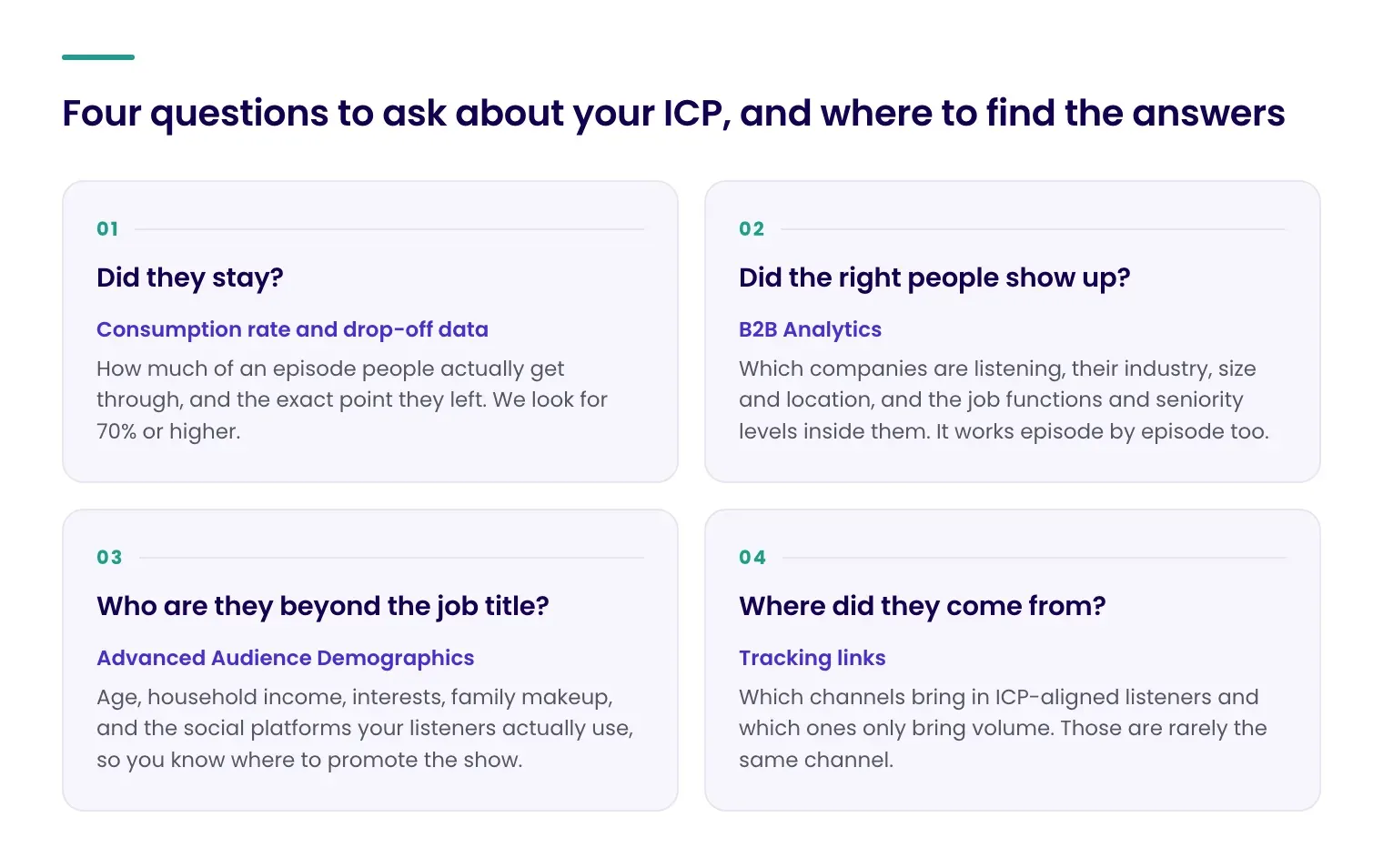
So you’re probably wondering: what is a “good” number of unique listeners or a strong consumption rate? As a whole, we encourage our clients to aim for 70% consumption or higher, but in terms of other reach or engagement benchmarks, there isn’t an industry benchmark waiting for you here.
Dania points out: “You’ll commonly hear me scream from the rooftops the importance of benchmarking against yourself in podcasting.” Most podcast data sits in a closed dataset, so your last season is the most honest comparison you have.
Decide who you’re targeting before you hit record
“It’s so important for brands to come to podcasting with a strategic lens,” Steph said. Before you produce anything, write down who you’re trying to reach: What companies they work for, their job role, their seniority, and what they’d actually want to listen to.
That does two things:
- The content gets sharper, because you’re making it for someone specific.
- You end up with something to measure against later, since you can filter your listener data by those same companies and job titles and see who actually turned up.
Dania built a version of this for a client that’s worth stealing: Four ICP criteria (company size, job title, location and seniority), with every listen scored against them. It turns a flat list of listeners into something closer to a funnel, and gives you a number that moves season over season.
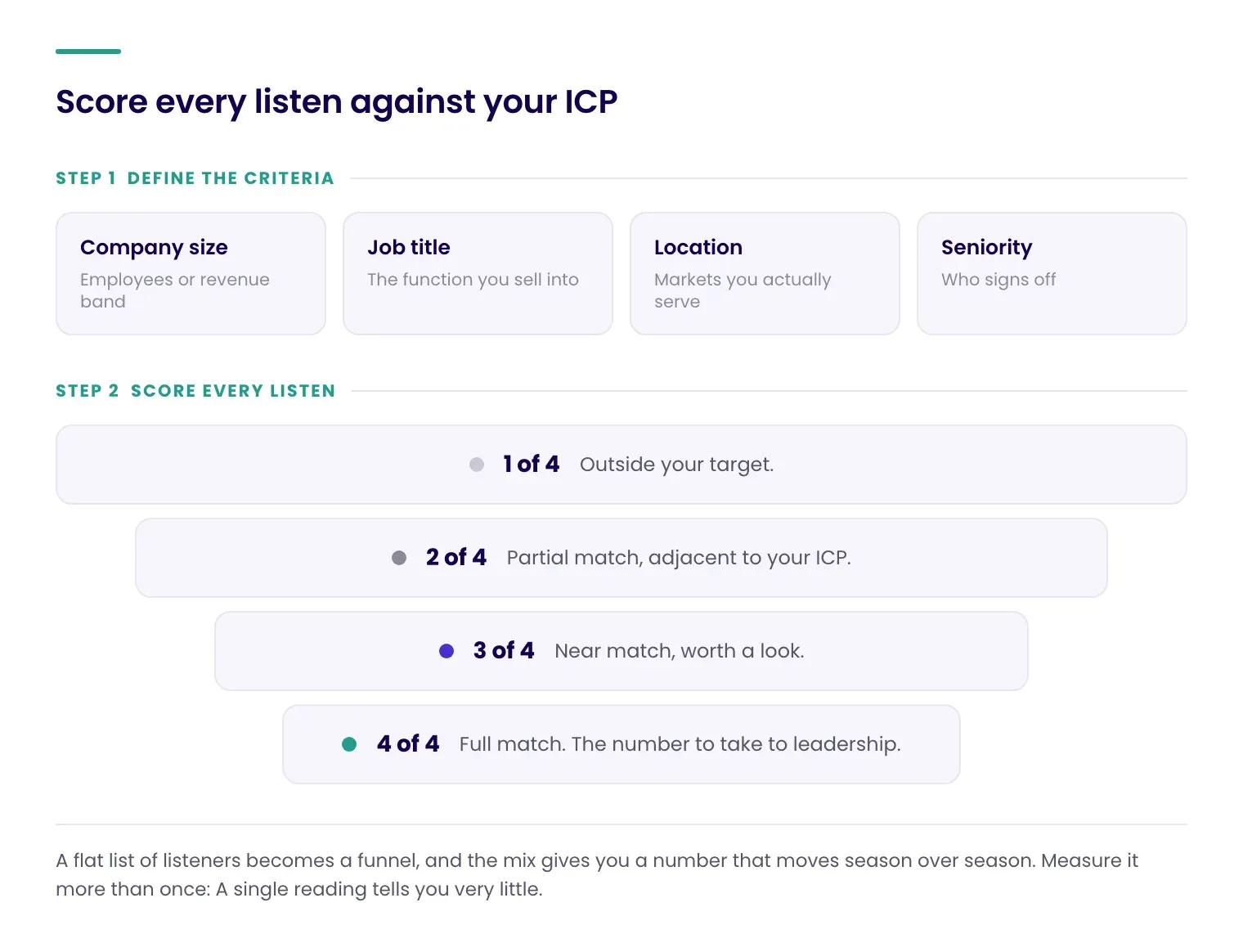
“A data point one time is relatively useless,” Dania said. “We have to measure these things over time.”
So what if the data comes back and you’re still not reaching (or resonating with) your ICP? There are three potential solutions:
- Change the content. If the topics and guests you publish aren’t what your ICP is picking, that’s what’s producing the mismatch. In this case, see which subjects your target accounts turn up for and make more of them.
- Change the marketing around it. Sometimes the show is speaking to the right listeners, but it’s being promoted in the wrong rooms. Check out your tracking link data to see which channels are bringing in the most listeners and your demographic data to see where your ICP is most active online.
- Put paid behind the accounts you want. If the right people are listening but there aren’t enough of them, the ICP profile you’ve built can drive the targeting on a growth campaign.
On the other hand, you may see that the right people are showing up, but they’re leaving early. Steph’s instinct here is to ask why before changing anything, and to think about the listener rather than the segment. “We need to maybe speak to the human aspect of the people who are actually consuming the content behind the screen,” she said.
Your drop-off data is where that starts, since it gives you the minute they left rather than an average. Then, you can spot patterns and see where exactly you’re losing a good chunk of your target audience. From there, you’ll be in a much better position to know if a segment needs tweaking, an ad needs to be swapped, or something else needs to be removed altogether.
Five ABM plays to run once you know who’s listening
1. Invite them on the show
Someone at a company you’d love to work with has listened to a handful of episodes. You already know they like what you make, so ask them to be a part of it.
“It’s kind of a hack, really, just to be able to get right in front of the people that you want to be on the pod,” Steph said.
This isn’t a sales call with a mic in front of it. It works because the invitation is genuine, and because the guest’s colleagues and larger network tune in. To make the most of the episode, ensure sharing is as easy as possible. Send your guest over some sample copy, a couple of clip options, a tracking link and hashtags.
Dania watched this play out on a client’s show. They’d had one of their partners on, and when they looked at the data later, that episode’s email campaign was outperforming all the others organically.
“We go back, we check the tracking links, and we see that a bunch of leads were generated,” Dania said. The guest worked at a large accounting firm, and the episode had made its way through their whole team.
2. Give sales the episode
Your listener data tells you which companies played which episodes. Hand that to your sales team, so your rep has a real reason to reach out instead of sending another check-in.
“There could be organizations listening that maybe you didn’t even think were,” Dania said. She has watched a client find a household name sitting in their B2B data and react with some version of “Disney’s listening to my podcast?” Her answer: “Yeah, Disney is listening to your podcast right now. What can we do about it?”
One of the best things you can do is pass this information off to sales to use in their outreach. Name the episode that the account played, then point them to another one they’d probably like. Steph pointed out it works after a call too, when you can send the exact section that relates to what you just discussed.
3. Add them to your ad targeting
Export the list of companies already listening and upload it as the target list for ads you’re already running, whether that’s LinkedIn or programmatic. You’re then paying to reach companies you know are interested, rather than an audience the ad platform guessed for you.
“That’s, I think, a lot smarter than just going out and running a random campaign and hoping that you’re going to hit the right people,” Steph said.
4. Move them up the outbound list
If a company is already listening to your show, your reps should be calling them before they call one that’s never heard of you. Listening moves a company up the list.
For that to actually happen, the data has to sit where your reps already work. Steph walked through our Salesforce integration, which matches each listen to the right company and puts it on that company’s record, next to everything else your team tracks, so nobody has to go digging through a monthly report to find it. Or if you’re not on CoHost, email sales a list of the companies listening once a month.
5. Let listening qualify the account
Decide up front what counts as a listener being engaged enough to qualify them. A workable threshold looks like this: Three or more episodes, played by someone at Director level or above, at a company in an industry you sell to. Any company that meets all three gets handed to sales like any other qualified lead.
You can build that today, because the B2B data lets you sort by company, job role, seniority and industry, then export the result as a list.
Two honest caveats:
- You have to set the rule and pull the list yourself, since nothing pings you when a company crosses the engagement threshold into “qualified”.
- What comes back is the company, the job role and the seniority, never a person’s name. To get actual names, put a gated resource in your show notes or match the firmographic data with a tool like ZoomInfo. A template or a report works fine, as long as someone has to enter an email to get it.
What to bring to leadership
“As long as you can justify who is listening and who is showing up, I think that’s going to be your most valuable piece,” Dania said.
Below is the comparison that follows from the session: What most podcast teams report today, against what actually gets through a budget review.
| Doesn't hold up | Holds up |
|---|---|
| Downloads are up this quarter | How many target accounts are listening |
| Average listens per episode | Which ones you reached for the first time |
| The audience growth chart | Which accounts sales prioritized as a result |
Nothing in the left column is wrong, and most teams report all three. They’re just answering “how many” when the question was “what did we get for the channel investment.” The left column describes the show. The right column describes the business, and the business is what leadership wants to know about.
In my opinion, “average listens per episode” is the clearest example. Ten target accounts finishing an episode and a thousand strangers sampling one are completely different results, and an average reports them as the same thing.
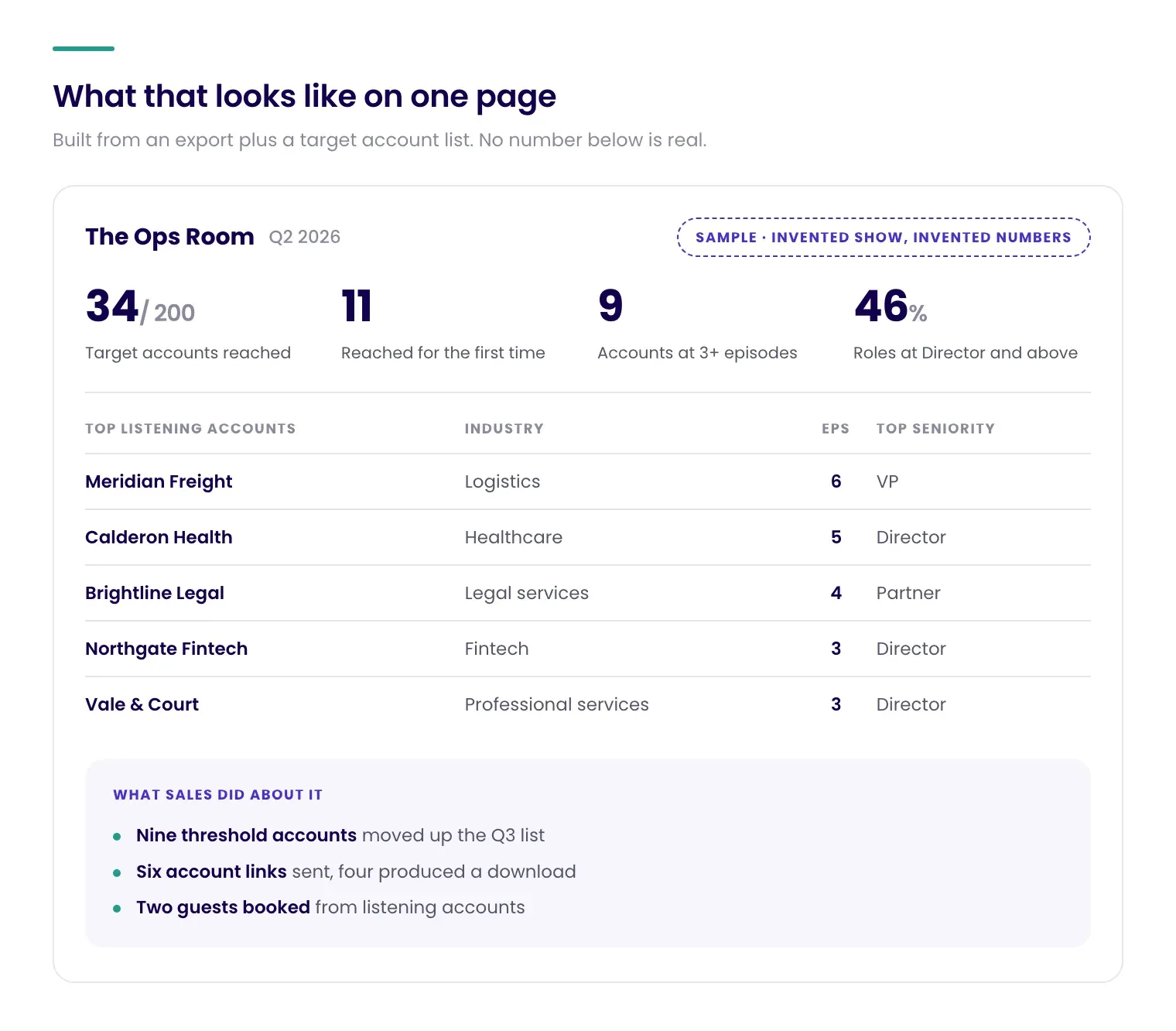
A report like this won’t give you airtight attribution, but it will help you defend the channel with a list of named companies, which is more than most podcast teams can do today.
The other two arguments we’d suggest bringing to the leadership meeting aren’t about your audience at all. They’re about what the show does for everyone else in the company:
A show that can prove who’s listening starts pulling people in. Dania had a client who spent a season proving the companies they cared about were tuning in. The year after, leadership came around and the team had more internal demand to appear on the show than they had episodes to fill.
The show is also saving other teams money. Every episode gets cut down into clips, social posts and newsletter content. That’s work the social team would otherwise be paying a freelancer for, which makes it a cost you can actually put a figure on. “That’s money saved. That’s an actual figure I can then go to my leadership with,” Dania said.
For Steph, the thing that holds all of it together is that every number above needs a goal sitting behind it.
“If you can’t connect that back to a goal, you can do all of these tactics, but you’re not going to be able to connect it back to something that actually matters to your bottom line,” Steph said.
So decide what the show is actually for. Awareness, thought leadership, lead generation, or closing the leads it brings in. If you want to go deeper on tracking branded podcast KPIs and proving ROI, our podcast ROI framework walks through the four inputs and the one number to report.
So, is your podcast an ABM channel?
It can be, as soon as you can name who’s listening. Everything in this session runs off that one thing. The five plays need a list of companies. The leadership report needs it. Without it, you’re back to reporting downloads, which is where we came in.
What I’d want you to take from this is that none of it asks you to make a different show. No bigger budget, no new format, no extra headcount. You write down the accounts you’re trying to reach, you check whether they showed up, and then you do something about it.
So if I were running a branded show this quarter, here’s where I’d start.
- Write down who you’re trying to reach. Companies, job titles, seniority levels. You can’t measure against a list you never made.
- Go and look at who’s already there. Many of your target accounts may already be listening.
- Get the list in front of sales. Export the companies already listening and send it over, so reps can see which of their accounts already know who you are.
- Change one line in your next leadership update. Swap “downloads are up this quarter” for “here are the target accounts that listened.”
If you’re curious what your own data looks like, book a demo, and we’ll show you which companies are already listening to your show.
To keep up to date with all future webinars, please visit our Brand Camp page. And if you want more podcast analytics tips in the meantime, subscribe to Tuned In, our bi-weekly newsletter.